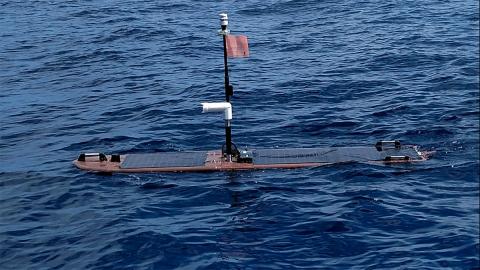
As the U.S. Navy continues to develop and integrate unmanned maritime systems into its repertoire, members of the government and the unmanned systems industry agree they will need to continue relying on each other to make these systems a regular part of the armed forces.
“What I really appreciate is industry’s willingness to get on board with the Navy’s vision for the family of systems that can be upgraded throughout their life,” said Capt. Pete Small, USN, program manager, PMS 406, on a government panel during the Unmanned Systems Integration Seminar, presented by the Naval Submarine League and AUVSI.
USV
USV
Speakers highlight importance of collaboration for developing, integrating unmanned maritime systems

Northrop Grumman's AQS-24 mine hunting sonar completes initial in-water testing of next-gen D&R payload
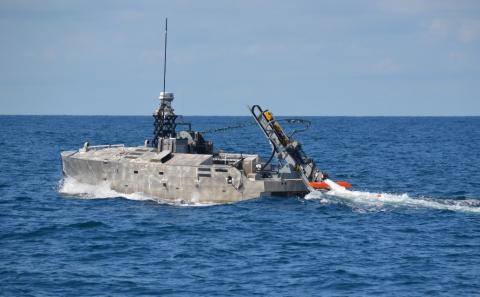
Northrop Grumman has announced that its AQS-24 mine hunting sonar recently completed initial in-water testing of a next-generation Deploy and Retrieval (D&R) payload.
The AQS-24 D&R operated from the Mine Countermeasures Unmanned Surface Vessel (MCM USV), and showcased the unmanned operations necessary to perform a mine hunting mission off the MCM Mission Package aboard the littoral combat ship (LCS).
Sonardyne-led team demonstrates benefits of USVs/AUVs for long-endurance underwater navigation missions
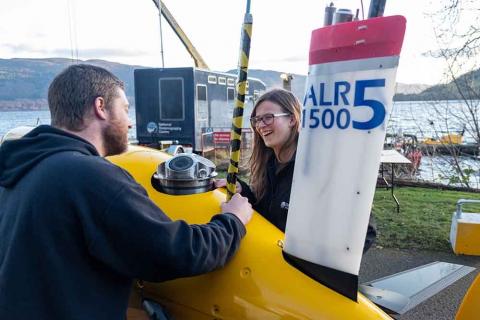
A joint project led by Sonardyne International Ltd., with partners the National Oceanography Centre (NOC) and L3Harris, has set “new standards in long-endurance underwater navigation and automated subsea positioning,” according to the entities.
One of the main goals of the two-year, £1.4 million Precise Positioning for Persistent Autonomous Underwater Vehicles (P3AUV) project was to integrate existing and emerging technologies to deliver a “step-change” in unmanned platform endurance and navigational precision.
The project also sought to use USVs to increase the use of autonomy in offshore survey positioning operations, which ultimately reduces risk to personnel, environmental impact and operating costs.
Mikros Systems awarded SBIR Phase I contract to develop software for USVs and UUVs
The Naval Sea Systems Command has awarded advanced technology company Mikros Systems Corporation a $150,000 Small Business Innovation Research (SBIR) Phase I contract for topic number N193‑A02: “Unmanned Surface Vehicle (USV) and Unmanned Underwater Vehicle (UUV) Autonomous Behavior Development.”
Through this contract, Mikros Systems will develop a Sensor In-stride Diagnostic, Correction, and Confidence Component (SID3C) that can be installed on current and future USV and UUV vehicle platforms. SID3C will monitor shipboard sensors and sensor data to detect degradation or failures and correct recoverable sensors. The component will also help autonomy systems appropriately filter unreliable sensor data.



Disaster responders use EMILY USV to provide aid in Bahamas following Hurricane Dorian
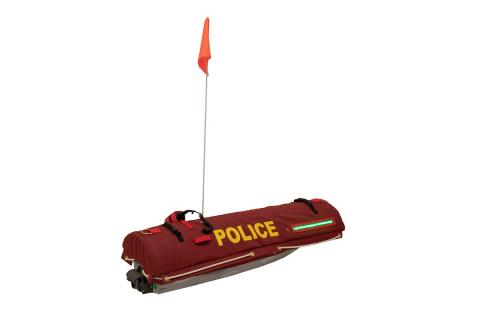
Following Hurricane Dorian’s destruction in the Bahamas last month, disaster responders used the Emergency Integrated Lifesaving Lanyard (EMILY) robotic lifeguard to provide islanders with medical care and supplies.
The remote-controlled USV is equipped with high-definition sonar and sophisticated sensors, which revealed underwater debris that could cause navigational hazards. Disaster responders were also able to map a safe passage through Marsh Harbor— a town in Abaco Islands, Bahamas—using the vehicle’s specialized software.
Within just two hours, the USV was ashore distributing critical supplies, and over the course of a week, EMILY mapped more channels in other storm-ravaged areas of the Bahamas.
From Unmanned Systems Magazine: Europe looks to unmanned systems for mine countermeasure work
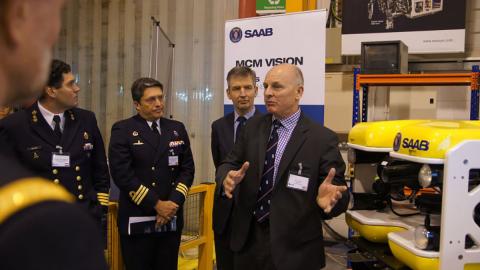
As increasing demands continue to be placed upon naval forces across the contemporary operating environment, European maritime forces are on the verge of successfully exploiting autonomous mine countermeasure (MCM) technology to not only save levels in manpower but also extend operational effectiveness.
Sea Machines, Metal Shark introduce new autonomous vessel
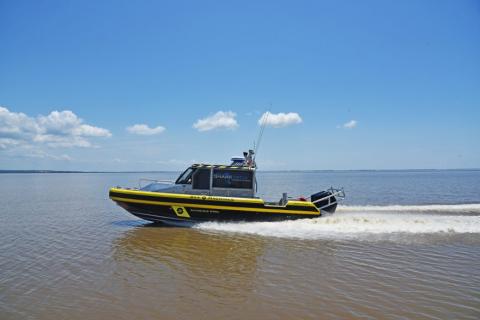
Sea Machines and shipbuilder Metal Shark have introduced a new 29-foot autonomous vessel, the Sharktech 29 Defiant welded-aluminum monohull pilothouse vessel, which is being offered through Metal Shark’s “Sharktech” autonomous division.
The Sharktech 29 Defiant is equipped with OEM-integrated, Sea Machines technology that offers a full range of advanced capabilities, including active control and collision avoidance.
With Sea Machines' system onboard the vehicle, several modes of operation are possible, including traditionally manned, reduced-crew or unmanned autonomous operations to deliver “human-in-the-loop” navigation during both line-of-sight and over-the-horizon operations.
AUVSI's Unmanned Systems and Robotics Database: An overview of commercial unmanned maritime vehicles
Unmanned vehicles operating in the maritime domain can be grouped into three main categories: Autonomous Underwater Vehicles (AUVs), Remotely Operated Vehicles (ROVs), and Unmanned Surface Vehicles (USVs). Each vehicle type offers unique capabilities which support a wide range of commercial applications.