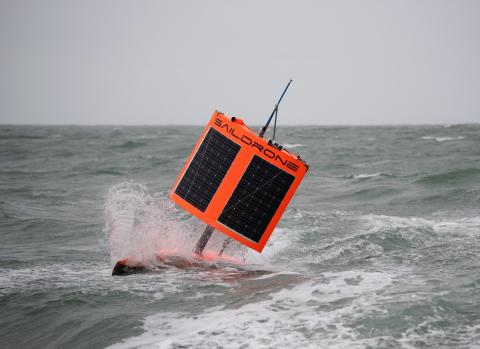
A wind-powered USV called the saildrone has become the first unmanned system to circumnavigate Antarctica.
Known as SD 1020, the vehicle, equipped with a suite of climate-grade sensors, collected data in previously unchartered waters, which will offer insights into ocean and climate processes.
SD 1020 launched on Jan. 19 of this year from Southport in Bluff, New Zealand, and returned to the same port on Aug. 3. Over the course of 196 days, the USV sailed more than 13,000 miles around Antarctica, surviving freezing temperatures, 50-foot waves, 80 mile per hour winds, and collisions with giant icebergs along the way.
USV
USV
EMILY USV saves four swimmers at Oregon beach
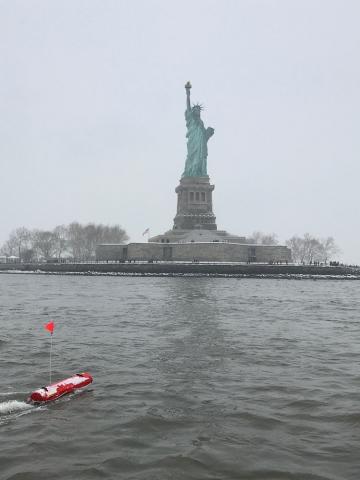
The Emergency Integrated Lifesaving Lanyard (EMILY) USV was recently used to rescue four swimmers from the ocean at Rockaway Beach in Oregon, according to KGW.com.
After training with the USV for about a year, the Rockaway Fire Department deployed EMILY for the first time on Monday, July 8, to save two young boys and their family members that tried to rescue them.
Exclusive: Q & A with Lt. Gen. Todd Semonite, 54TH chief of engineers and commanding general of The U.S. Army Corps of Engineers
Lt. Gen. Todd Semonite assumed his position as Chief of Engineers and Commanding General of the U.S. Army Corps of Engineers (USACE) on May 19, 2016.As the USACE commanding general, he is responsible for more than 32,000 civilian employees and 700 military personnel who provide project management, construction support and science and engineering expertise in more than 110 countries.
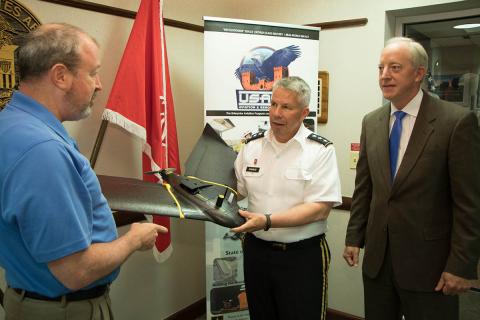
UAV Navigation announces autopilot for USVs and ASVs
UAV Navigation has announced that it has developed an autopilot for USVs and ASVs.
Designed to comply with IP66—which means that it can work in humid conditions, including salt spray and saline environments—UAV Navigation’s autopilot is capable of completely autonomously controlling a USV mission from beginning to end.
According to UAV Navigation, all of the advanced features available for UAS can be used by USV operators, including multiple waypoints, multiple onboard mission plans, and no-go zones.
One of the most useful features of the autopilot, according to UAV Navigation, is ‘relative routes,’ which is the ability to install the Ground Control Station (GCS) on a moving ship, and then to fix a mission plan relative to the moving vessel.
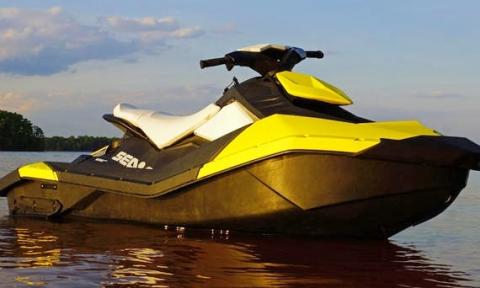
Spatial Integrated Systems announces extension of USV Swarming program
Spatial Integrated Systems Inc. (SIS), an engineering design and development company, has announced the extension of its USV Swarming program under the auspices of the Office of Naval Research (ONR).
According to SIS, USV Swarm 2019 will be the first integrated heterogeneous eight USV Swarm of autonomous Very Small (class 1) and Small (class 2) USVs. The USVs will conduct a coordinated mission.
The goal of Swarm 2019 is to showcase the utility of very small and small, inexpensive USVs that can be produced in large numbers quickly, SIS says.
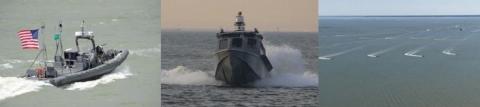

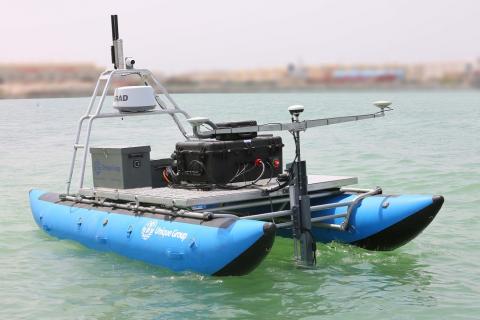
Unique Group launches Uni-Cat USV
Unique Group, a provider of integrated subsea and offshore technologies, has announced that launch of its first USV, Uni-Cat.
According to Unique Group, Uni-Cat has proven hydrographic survey capabilities, making it effective for bathymetry survey offshore and in shallow waters. The ideal use for the USV is in locations where conventional survey methods are not practical.
Kongsberg Maritime unveils new Sounder USV System
During Ocean Business 2019, Kongsberg Maritime unveiled its new Sounder USV System, which is designed and built to provide the “highest possible standard of data acquisition,” Kongsberg says.
Shortly after unveiling the new Sounder USV System, Kongsberg announced that it had signed a contract to deliver the Sounder USV System to the largest fishing company in Peru, TASA.
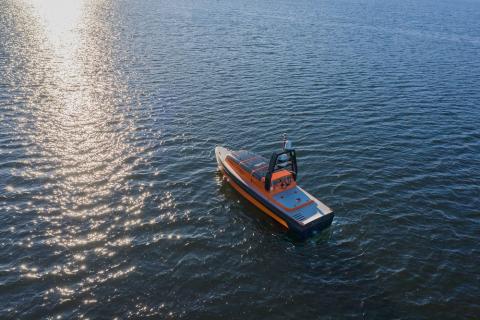
Embry-Riddle's Minion ASV impresses during Maritime Robot X Challenge
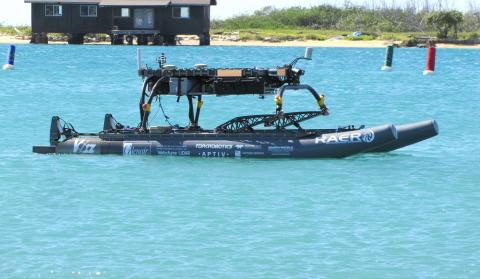
Students at Embry–Riddle Aeronautical University recently debuted their Minion autonomous surface vessel during the Maritime Robot X Challenge in December 2018.
Built by engineering student members of the Robotics Association at Embry–Riddle, the 16-foot long boat navigated an open water obstacle course, adapted to the waves and wind on the bay, and launched and recovered a small submarine before returning to dock.
According to Embry-Riddle, the Minion was created to compete in the Maritime Robot X Challenge, which is a weeklong biennial international competition co-sponsored by the Office of Naval Research (ONR), RoboNation, and a Hawaii-based company called NAVATEK that designs ships and other amphibious vehicles.