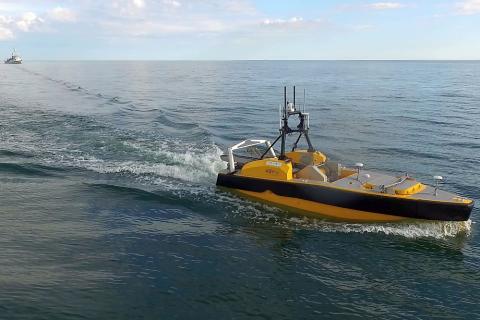
ASV Global will supply the University of Southern Mississippi (USM) with its state-of-the-art C-Worker 5 USV, after USM awarded a contract to the USV company.
The C-Worker 5 USV will reportedly be used for “testing, training, and establishing procedures and protocols” for use of the system by NOAA on future hydrographic programs.
“We are delighted to be working with the USM,” says Thomas Chance, CEO ASV Global.
“The C-Worker 5 is the ideal platform for survey work; to date, more than 11,000 km of hydrographic surveys have been performed with C-Worker 5 USVs, far more than any other diesel powered USV worldwide.”
USV
USV
Weekend Roundup
This Week in the Unmanned Systems and Robotics World
From April 19 to 20, the UAS/Drones for Disaster Response conference will help key stakeholders that are responsible for responding to disasters better understand how UAS and other unmanned systems can enhance their efforts during missions. The conference will be held at the Biscayne Bay Campus of Florida International University. (PR Web)

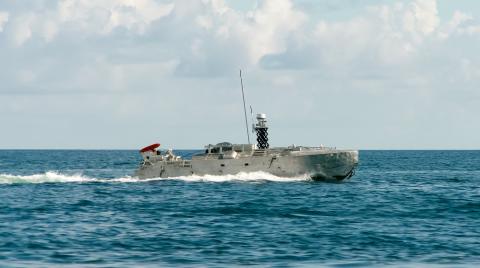
DARPA successfully completes ACTUV program, ACTUV "Sea Hunter" Prototype transitions to ONR
DARPA has announced that it has successfully completed its Anti-Submarine Warfare (ASW) Continuous Trail Unmanned Vessel (ACTUV) program.
The technology demonstration vessel, christened Sea Hunter, has officially been transferred to the Office of Naval Research (ONR). ONR will continue developing the vehicle, which is described as “the first of what could ultimately become an entirely new class of ocean-going vessel able to traverse thousands of kilometers over open seas for months at a time, without a single crew member aboard—as the Medium Displacement Unmanned Surface Vehicle (MDUSV).”
Production CUSV to gain new sonars, begin testing and demonstration
Textron’s Common Unmanned Surface Vehicle program will see two production vehicles built this year, with new side scan sonars being integrated and testing and demonstration to continue through 2019.
Textron began its CUSV program in 2008, after migrating its core competency — command and control for automated systems — from the air domain to the maritime.
GEBCO-NF Alumni Team completes Technology Readiness Tests of its AUV-USV concept
On Nov. 23, the GEBCO-NF Alumni Team completed Technology Readiness Tests of its AUV-USV concept and “associated combination of communications hardware and software” to process and transmit data remotely.
One of 19 semi-finalist teams competing in the $7 Million Shell Ocean Discovery XPRIZE competition, the GEBCO-NF Alumni Team received support from KONGSBERG experts and technology during the test event, which was held on the fjord outside KONGSBERG's factory in Horten, Norway.
Weekend Roundup
This Week in the Unmanned Systems and Robotics World
NBA superstar LeBron James is headlining a broadcast and digital ad campaign that seeks to build trust in autonomous vehicles. Produced by Intel, the first ad shows James expressing hesitation about riding in a self-driving car. After being convinced to take a ride in the vehicle, James gives his approval of the technology at the end of his ride, saying “hey yo, I’m keeping this,” by the end of the ad. (The Verge)

Australian Institute of Marine Science uses Wave Glider USV to monitor Great Barrier Reef
The Australian Institute of Marine Science (AIMS) and Boeing recently used the Liquid Robotics-developed Wave Glider USV to complete a seven-day open water mission, which was the “first major milestone of a five-year joint research agreement” between the two companies.
The mission, which covered 200 nautical miles including parts of North Queensland’s Great Barrier Reef, showcased how the Wave Glider could evaluate the health of the coral reefs and ecosystems.
From Unmanned Systems magazine: Navy plans 'simpler truck' for its unmanned countermine mission
The U.S. Navy still plans to hunt for maritime mines using autonomous craft but the service likely will attack the problem from a different angle, says Adm. John Richardson, the chief of naval operations.
For much of the past decade, the Navy worked off a plan to replace its aging wood-hulled mine-hunting boats mostly with a network of systems launched from the service’s new littoral combat ships (LCS), anchored by an unmanned underwater vehicle called a Remote Multi-Mission Vehicle (RMMV) that would launch from the LCS and lead the mine-finding and destroying operations, relying on the most advanced sensors and associated equipment.
Lockheed Martin Ventures invests in Ocean Aero, maker of the Submaran unmanned maritime vehicle
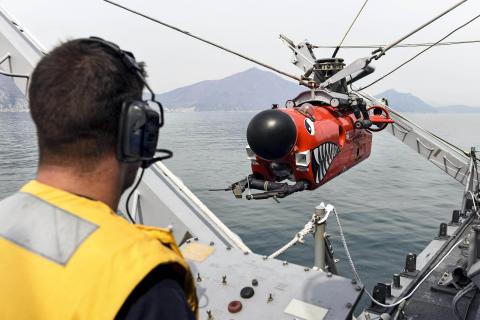
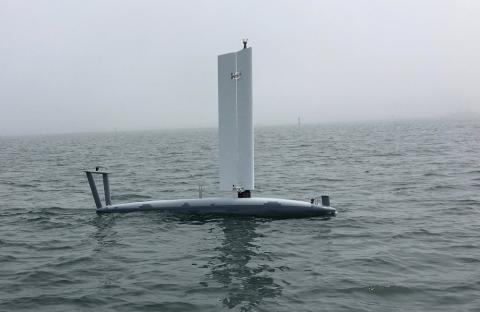
Lockheed Martin Ventures has announced that it is making a strategic investment in Ocean Aero, a company that has developed an unmanned maritime vehicle called the Submaran.
Built for ocean observation and data collection, the Submaran is a new class of unmanned underwater and surface vessel. The vehicle, which is powered by wind and solar energy, can travel for months, even in extreme conditions.
Easily deployable and recoverable, the vehicle can avoid surface traffic or conduct C4ISR operations thanks to its ability to dive to depths of 660 feet.
Weekend Roundup
This Week in the Unmanned Systems and Robotics World
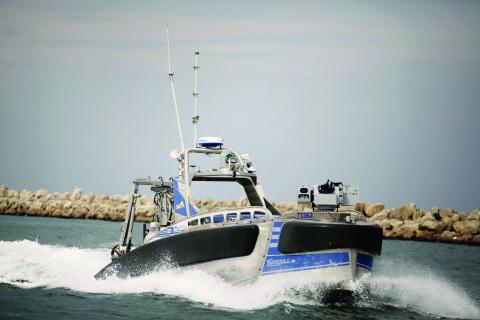
Elbit Systems’ multi mission USV, named Seagull, performed a live demonstration of a remotely operated Anti-Submarine Warfare (ASW) mission. Via Satellite Communication (SATCOM), the Seagull USV performed the operational ASW mission using control consoles located approximately 3,515 kilometers away in Elbit Systems' booth at the DSEI Exhibition in London. The Seagull USV was sailing in the Haifa Bay, Israel during the demonstration. (Elbit Systems)