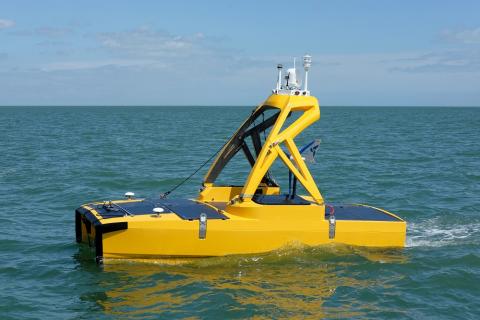
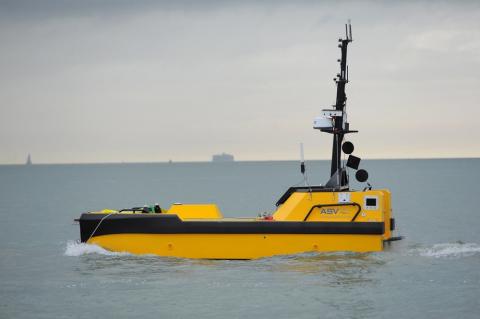
L3 ASV has delivered a long-endurance autonomous vessel known as the C-Enduro to the Royal Navy.
According to L3 ASV, the vessel will be used for military data gathering trials by the Mine countermeasures and Hydrographic Capability (MHC) program, as the Navy looks to utilize autonomous technology.
“We are proud to support the Royal Navy in their plans to explore the uses of marine autonomy as they continue to invest in new and exciting technology,” says Vince Dobbin, sales and marketing director for L3 ASV.
USV
USV
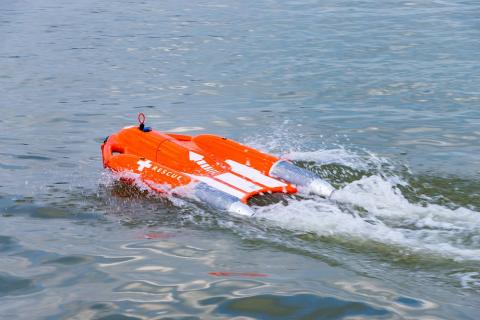
OceanAlpha's latest USV can be used for entertainment and lifesaving purposes
This week during CES 2019, USV company OceanAlpha unveiled its new Smart Jetboard FF I USV, which the company says can serve as both a lifebuoy and a jetboard.
Described as a “three-segment board,” the Smart Jetboard FF I is approximately one meter long, 0.8 meters wide, and weighs 13 kilograms. It utilizes a dual-jet pump with a battery life of 30 minutes and a maximum speed of five meters per second.
For use as a water entertainment device, the Smart Jetboard is equipped with direction and speed buttons that allows a user to lie comfortably and safely on the board, and navigate with ease.
PowerVision Technology Group unveils new unmanned water technology
During CES 2019, UAS, robotics and data technologies’ company PowerVision Technology Group announced its new water drone offerings, which include PowerDolphin, PowerRay, and PowerSeeker.
Each offering is equipped with its own unique capabilities.
Capable of capturing 4K photography and video, PowerDolphin is equipped with both intelligent fishing functions and water mapping functions. With its external mounting equipment, the platform can find fish, lure fish, and perform troll fishing. It can also directly tow hooks and lure fish to any desired location.
Additionally, PowerDolphin’s front nose has a 220-degree dual-joint rotation 4K camera, allowing it to capture photos or video above water and underwater.
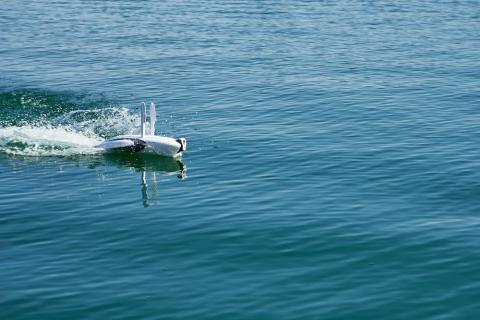
UAVOS completes development of USV
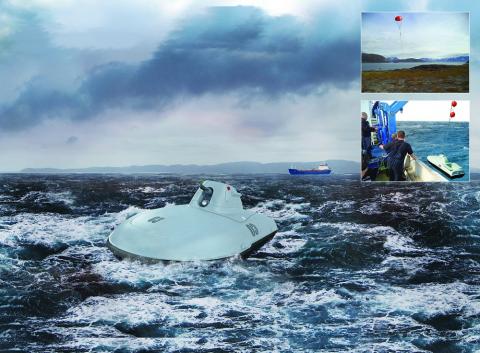
UAVOS has completed the development of a USV. The towing vehicle is designed to deliver a refueling hose to the land in remote and offshore locations beyond inhabited areas.
The USV will serve as an alternative to manned boats, which often times can’t come near the coast due to strong waves or other natural factors, UAVOS notes. UAVOS says that its USV is built to address the issue of delivering fuel or cargo to hard-to-reach coastal areas.
Harris Corporation and L3 technologies merging to create L3 Harris Technologies
In an effort to create a global defense technology leader that focuses on developing “differentiated and mission critical solutions” for customers across the globe, Harris Corporation and L3 Technologies Inc. have agreed to combine in an “all stock merger of equals” that results in a combined company called L3 Harris Technologies Inc.
Both companies are fully invested in the world of unmanned systems, as L3 recently acquired ASV Global—a USV and autonomous vessel control systems company—to create L3 ASV, while Harris is an FAA-approved vendor of the LAANC service, which provides UAS with access to the controlled airspace near airports.

AutoNaut USV looks to play a role in removing plastic from the world's oceans
An AutoNaut USV has been launched alongside “Wilson,” which is the Ocean Cleanup System 001 from a non-profit organization called The Ocean Cleanup that is deploying advanced technologies to remove plastic from the world’s oceans.
While deployed, the AutoNaut USV will conduct long-term monitoring of the surrounding environmental conditions. It will also provide information on “Wilson” itself, which is currently undergoing sea trials approximately 350 nautical miles from San Francisco to test the behavior of the system.
“We are thrilled to be playing a role in Boyan Slat’s vision,” says Phil Johnston, BD at AutoNaut.
L3 Technologies acquires USV and autonomous vessel control systems company ASV Global
On Sept. 20, L3 Technologies acquired ASV Global, a USV and autonomous vessel control systems company.
This acquisition “strategically enhances” L3’s full spectrum of unmanned maritime capabilities, which includes integrated anti-submarine warfare (ASW) technologies, future surface combatant unmanned off-board sensors, and integrated USV and UUV operations.
The acquisition will result in a new company known as L3 ASV.
Liquid Robotics' Wave Glider USVs help study effects of lava flow from Hawaii's Kilauea Volcano
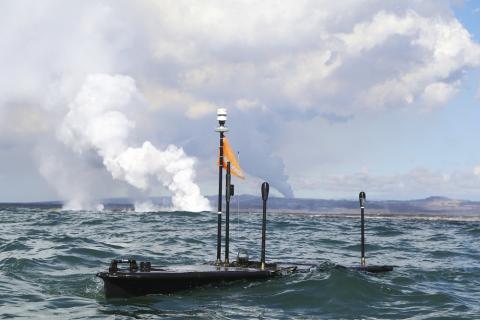
Liquid Robotics recently deployed two of its Wave Glider USVs to help scientist study the effects of the lava from Kilauea Volcano in Hawaii when it enters the ocean and the large plume it creates, as well as the impacts on marine life.
As evident by its name, the Wave Glider is wave powered, meaning that it doesn't require any fuel power other than the waves of the ocean to carry it place to place. In this particular use case, Wave Gliders provide researchers a no risk way to monitor the volcanic activity.
Liquid Robotics' Wave Gliders USV selected to conduct scientific research in Arctic and Southern Oceans
Liquid Robotics’ Wave Glider USV has been selected as the sensor platform to conduct advanced scientific research in the “most inhospitable and remote regions” of the Arctic and Southern Oceans by top oceanographers from Scripps Institution of Oceanography (Scripps) and the Applied Physics Laboratory of the University of Washington (APL-UW).
Textron Systems' CUSV demonstrated on Potomac River Test Range
On March 28, Textron Systems' Common Unmanned Surface Vehicle (CUSV) autonomously conducted maneuvers on the Potomac River Test Range during a demonstration before an audience made up of government, defense contractors, and military personnel.
During the event, Navy and corporate leaders discussed their collaboration to weaponize a CUSV capable of multiple missions.
“The reason we collaborate is because we as a nation find ourselves in a situation where we can no longer take time to deliver capability to our warfighters,” says John Fiore, Naval Surface Warfare Center Dahlgren Division (NSWCDD) technical director, during the March 28 event.