This Week in the Unmanned Systems and Robotics World
Self-driving Cars
Self-driving Cars
Hawaii teachers learning how to code driverless cars
In Hawaii, some teachers are taking a six-day class to learn how to code driverless cars, in a first of its kind program that could become a part of the curriculum in Hawaii.
Teachers are learning the basics of coding, but the language is the same as what’s being used to program the same driverless cars that are currently on, or one day will be on, roads across the United States and all over the world.
The course is being taught by Sumil Thapa, who is an engineer for a Hawaii-based engineering consultant called Oceanit. One day, Thapa taught the teachers how to program their cars to “drive into a mini garage, sense the light, back up out of the garage and then give out the light reading.”

Self-driving cars to be tested on interstates in Northern Virginia
According to WTVR.com, self-driving and wireless connected cars are headed to the roads in Virginia, after the Commonwealth Transportation Board approved the testing of these vehicles in High Occupancy Toll (HOT) lanes on Interstate 95 and Interstate 495 in Northern Virginia.
Initially, the cars will be tested on closed roads, but eventually, they will be tested during “light traffic” times.
According to Virginia Department of Transportation Research Director Cathy McGhee, fellow occupants on the road should not notice anything unusual once these self-driving vehicles begin testing.

Toyota announces new venture capital fund for autonomous vehicles
Have some good ideas for autonomous vehicle technology? The Toyota Research Institute would like to hear about it, and may be willing to fund it and become a customer.
Gil Pratt, the former DARPA roboticist who is now COE of the TRI, announced a new venture fund named the Toyota AI Ventures at the Automated Vehicles Symposium on Tuesday, July 11, held by AUVSI and TRB in San Francisco.
The idea is to invite innovative companies “to join us in trying to move this field forward,” Pratt said.
TRI was founded just last year with a $1 billion investment, and has quickly grown from zero employees to 200. Toyota AI Ventures is funded to the tune of $100 million from the $1 billion that TRI itself was founded with just last year.
Torc Robotics unveils self-driving initiative
Blacksburg, Virginia-based Torc Robotics has officially announced that it is developing a “complete self-driving system for consumer automobiles.”
The autonomous vehicle technology company, which is a level 4 company in terms of the Society of Automotive Engineers’ (SAE) levels of automated driving, says that vehicles equipped with its self-driving technology, including its end-to-end software stack, can make complex decisions in real life scenarios on the road.
“We’re offering automotive companies a fully autonomous solution that can be implemented in real consumer cars,” says Torc co-founder and Chief Executive Officer Michael Fleming.
Weekend Roundup
This Week in the Unmanned Systems and Robotics World
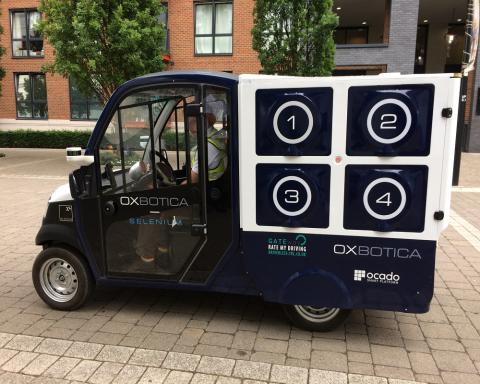
An Oxbotica-developed autonomous vehicle called CargoPod is being used in London to deliver groceries to customers. The vehicle has eight pods on the back of it, and each pod has a crate that can hold three bags of groceries. After the vehicle is filled by human hands from a small distribution center, it sets off following a route to its drop-offs. Once the CargoPod arrives at its destination, the customer is alerted through a smartphone. That customer must then press a button on the vehicle to open the pod door, allowing them to collect their groceries. (MIT Technology Review)
NuTonomy and Lyft to test self-driving vehicles in Boston
NuTonomy and Lyft have agreed to a research and development partnership that will result in the two entities testing self-driving vehicles in Boston in the “coming months.”
Through the partnership, the companies will “align their respective technology platforms to gather valuable research and insights into all aspects of ensuring a passenger’s comfort and safety during an autonomous vehicle (AV) ride.” Those aspects will include everything from routing and booking, to how the driving system performs, interacts and communicates with the rider.
Driverless Vehicles Could be Headed to Calgary as a Part of Pilot Project
Driverless vehicles could be tested in Calgary, Canada, if a pilot project presented to the city's transportation committee on May 17 is approved.
If approved, a low-speed autonomous shuttle service would be tested in the city next year. The shuttle, which would be capable of holding up to 10 people while traveling just under 20 km/hr, would be used to carry guests to and from the Calgary Zoo LRT station and Telus Spark.
“This could be a very interesting pilot and a way to celebrate the good that autonomous vehicles can bring,” says City Councillor Gian-Carlo Carra through the Calgary Sun.
FirstGroup to work on shared autonomous vehicle research at automated vehicle proving ground in California
A transport operator called FirstGroup will conduct research on shared autonomous vehicles at the Concord, California-based GoMentum Station, after signing an agreement with the federally designated automated vehicle proving ground.
Through the partnership, First Transit, which is a United States division of the United Kingdom-headquartered FirstGroup, will use the 2,000-hectare test facility as a test site for “innovative transport applications.”
One of the applications that First Transit will use the test facility for is a pilot project that began back in 2016, which seeks to deploy the “first commercially operated shared autonomous vehicle on public roads in the United States.”