
Privacy Policy
Self-driving Cars
Self-driving Cars
Unmanned Systems Defense Phase I: Ground
Today, AUVSI hosted Day Three of the 2021 Unmanned Systems Defense (USD) Conference with a focus on technologies and systems within the ground domain. During the keynote address and panel discussion, attendees learned about key capabilities DOD will seek out in new systems and heard from private sector stakeholders about how emerging technologies can meet needs in both the commercial market and the defense and military ecosystem.
MG Ross Coffman, Director, Next Generation Combat Vehicle - Cross Functional Team, expressed his appreciation in his keynote address for the way the unmanned industry collaborates and learns from each other. He urged the industry to work together to solve cross-functional challenges: “Together, we can solve really complex problems.”
FL Sen. Jeff Brandes Continuing to Lead on AV
In late February, Florida State Senator Jeff Brandes (R-FL-24) introduced a bill authorizing the operation of low-speed autonomous vehicles (AV) on certain streets and roads. Long a champion of AV innovation and adoption, AUVSI commends Sen. Brandes for continuing to push these issues forward and establish Florida as a leader of autonomous technology.
'Disruptive Women' summit to spotlight cutting-edge AV technologies and female leaders helping to bring them to the fore
The trigger for the upcoming virtual summit, “Disruptive Women Powering Our Autonomous Future,” won’t likely make any history books, but it felt like a milestone – or at least an aha moment.
Pamela Gauci, events director for Velodyne Lidar, was reviewing the lineup for a panel discussion that was to be part of another event that the company hosts, an annual conference on safety and autonomous vehicles. With her was Sally Frykman, Velodyne Lidar’s chief marketing officer.
Neither the general topic of that other conference nor the specific topic designated for the panel – the regulatory road ahead – had anything to do with gender. Yet every expert on the list was a woman.

Disruptive Women Powering Our Autonomous Future
The AV industry is already set firmly on course to alter the very fabric of our global infrastructure and society. As the industry expands, women are increasingly filling roles as CEOs, C-suite executives, and engineers within this relatively young and lightning-paced mobility sector. We often assume the technology introduced into our daily lives has been designed and developed by those who represent our society as a whole. However, the statistics tell a different story. To address this, we will discuss female representation within the AV industry, elevating women into positions of power to affect change and supporting young girls with the desire to forge a career in AV technology.
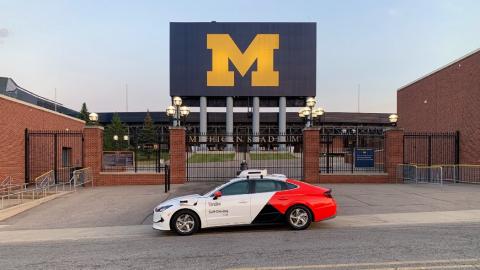
Yandex selects Ann Arbor, Michigan as next testing location for its self-driving cars
Yandex has selected Ann Arbor, Michigan as the third urban testing ground for its self-driving cars.
A variety of factors make the city of Ann Arbor an ideal testing place, Yandex says, including the city’s wealth of research and engineering facilities and many bright young minds, and the state’s “very progressive and supportive” regulatory environment for the development of self-driving cars.
Ann Arbor joins Moscow and Tel Aviv as Yandex's other self-driving testing locations. According to Yandex, it will have more autonomy in Ann Arbor than it does in Moscow and Tel Aviv, as those two locations require engineers to be behind the wheel of self-driving vehicles at all times.
Swarming robots avoid crashes, jams using algorithm developed by Northwestern University researchers
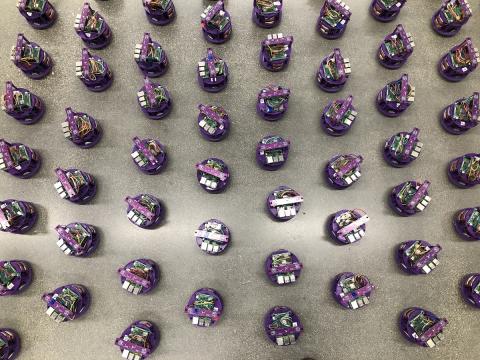
Northwestern University researchers have developed what they are calling the “first decentralized algorithm with a collision-free, deadlock-free guarantee.”
The algorithm could potentially one day help self-driving vehicles navigate one another safely and flawlessly without crashing or causing unnecessary traffic jams, but for now, it is helping robots avoid crashes and jams. The algorithm was tested in a simulation of 1,024 robots and on a swarm of 100 real robots in the laboratory. In less than a minute, the robots reliably, safely and efficiently converged to form a pre-determined shape, as you can see below:
RoboSense LiDAR and the future of self-driving cars
To achieve large-scale commercialization of autonomous vehicles, a new generation of high-precision 3D environment sensing solid-state LiDAR technology products will be required to fulfill the industry’s strict requirements.
Q&A with Dr. Leilei Shinohara, VP of R&D

Uber Advanced Technologies Group begins collecting self-driving tech data in D.C.
Uber Advanced Technologies Group (Uber ATG) has selected Washington, D.C. as its next location to collect data for its self-driving vehicles.
Uber ATG’s self-driving cars will begin operating on the roads of D.C. beginning Friday, Jan. 24, to collect data, but the vehicles will be in manual driving mode, so a Mission Specialist—a specially trained vehicle operator—will always maintain control of the vehicle.
“We are using a phased approach to develop and deploy our self-driving vehicles, taking the necessary steps to operate safely in every city,” Uber ATG says.
MIT helps automated vehicles see around corners
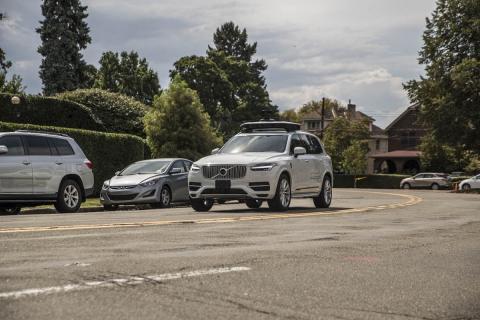
MIT researchers have developed a system that can sense tiny changes in shadows on the ground to help autonomous systems determine if a moving object is coming around a corner.
This work, funded by the Toyota Research Institute, could one day help keep self-driving cars from hitting other cars or pedestrians or help guide robots through hospital hallways as they deliver medicine or supplies.
MIT researchers conducted experiments with an autonomous vehicle driving around a parking garage and a self-driving wheelchair moving through hallways. in a paper presented at the International Conference on Intelligent Robots and Systems, they said the new system bested traditional lidar systems by more than half a second — not a lot, but enough to forestall accidents.