
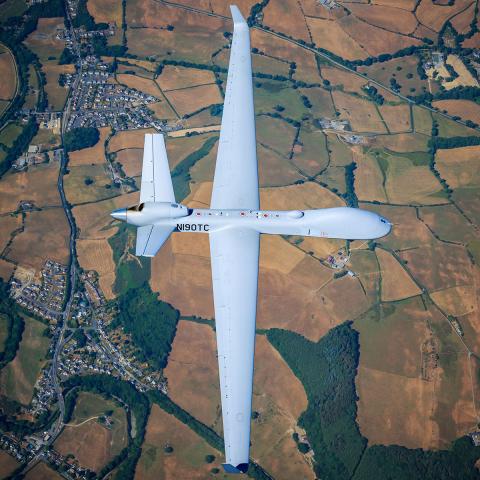
As part of NASA’s project to integrate UAS into the National Airspace System (NAS), General Atomics Aeronautical Systems Inc. (GA-ASI) is partnering with NASA to conduct a demonstration flight.
Scheduled for 2020, the demonstration will seek to address some of the challenges that prevent routine commercial UAS operations in the NAS today. These challenges include development, integration, and certification of UAS, as well as the technologies needed for safe operation with other manned and UAS traffic in the NAS.
“NASA and GA-ASI have a shared goal of seeing UAS fly safely and unencumbered in the NAS,” says Linden Blue, CEO, GA-ASI.
Airspace
Airspace
Task force on drone incursions at airports calls for coordination, federal funding
The Blue Ribbon Task Force on UAS Mitigation at Airports, commissioned by AUVSI and the Airports Council International-North America (ACI-NA), released its final report today and recommended that federal governments should work with airports to fight drone incursions and get additional funding to help accomplish that.
The task force also says there is an "urgent need" for the Federal Aviation Administration and Transport Canada to establish drone detection standards and that local law enforcement has a role to play, beginning with a pilot program to demonstrate how that would work.

Speakers highlight importance of Remote ID rulemaking, safe operations during Hill Day
One of the biggest topics of discussion during AUVSI’s annual Hill Day on Wednesday, Sept. 25 was remote identification and the progress, or lack thereof, on this rulemaking.
“This is one issue we’re not going to let up on,” said Rep. Daniel Lipinski.
Like many in the UAS community, Lipinski, who co-chairs the House UAS Caucus, believes the FAA is moving too slow on the rules for remote ID. These sentiments were echoed by Rep. Sam Graves, the ranking member of the House Transportation and Infrastructure Committee.
“I think that has a lot to do with the simple fact that I don’t think they really know which direction they’re going,” Graves said.

Flylogix Limited, partners launch North Sea drone initiative
‘Beyond the Horizon’ UAS company Flylogix Limited has announced the launch of a North Sea drone initiative in collaboration with multinational integrated oil and gas company Total S.A., UK air traffic navigation services provider NATS, and the Oil & Gas Technology Centre (OGTC).
The project will seek to overcome the challenges associated with UAS inspection activities in the North Sea, and look to provide commercial UAS operators with easier access to UK controlled airspace for beyond visual line of sight (BVLOS) operations.
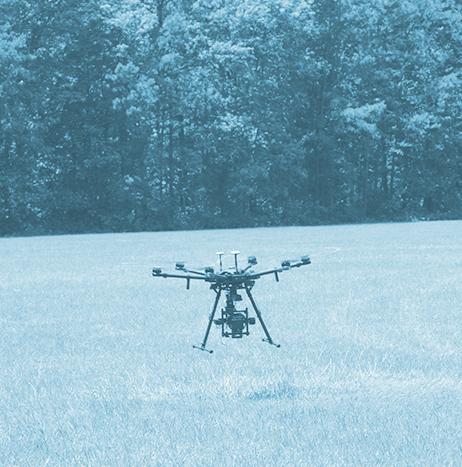
Raytheon, AirMap collaborating to safely integrate UAS into national airspace system
Raytheon and AirMap have announced that they will collaborate on future projects to safely integrate UAS into the national airspace system, and “unlock the positive economic and social benefits of expanded commercial drone operations.”
The agreement combines the expertise of each company. Air traffic controllers across the U.S. use Raytheon's Standard Terminal Automation Replacement System (STARS) to provide safe and efficient aircraft spacing and sequencing guidance for more than 40,000 departing and arriving aircraft daily at both civilian and military airports.

WhiteFox releases white paper outlining path forward for the integration of UAS into National Airspace
In response to events both domestic and abroad, WhiteFox has developed and released a new white paper entitled ‘Enabling the Good While Preventing the Bad: How Security Enables the Drone Industry.’
In the white paper, which highlights “the need to protect against potential public safety and homeland security threats posed by UAS,” WhiteFox outlines what it calls “critical recommendations for a comprehensive counter-UAS legislative framework.”
Black Swift Technologies' S2 UAS to be deployed in Greenland for atmospheric research studies
Black Swift Technologies (BST) has announced that its Black Swift S2 UAS will be used to conduct high-altitude high-latitude atmospheric research studies in Greenland, as part of the international East Greenland Ice-Core Project (EastGRIP).
With support from the National Science Foundation (NSF), the work will be conducted by the Institute of Arctic and Alpine Research (INSTAAR), which is part of the University of Colorado Boulder.
The Black Swift S2 will operate at temperatures as low as -20 degrees Celsius or colder, and will be flying at altitudes up to 14,000 feet— right on the edge of commercial airspace, Black Swift notes—to make routine atmospheric measurements.

AirMap and Honeywell developing UAS tracking platform
To provide airspace safety authorities with situational awareness of both unmanned and manned aircraft operations within an airspace system, AirMap and Honeywell have announced the development of a cost-effective UAS tracking platform.
The companies say that they will collaborate on the development of a cost-effective hardware device that allows UAS to maintain consistent communication with a UAS Traffic Management (UTM) system.
The UAS tracking platform will support several communication options, including 4G and satellite in areas without 4G coverage, to facilitate the broadcast of real-time drone telemetry feeds to a UTM system.
PAE ISR demonstrates Resolute Eagle UAS during first meeting with NASA and FAA
PAE ISR recently hosted a joint kickoff meeting with NASA and the FAA as part of the UAS integration in the National Airspace System (NAS) Project.
During the meeting, which took place at the Pendleton Unmanned Aerial Range, PAE ISR presented an overview of its solutions package for the 2020 program, and conducted a flight demonstration of its Resolute Eagle UAS.
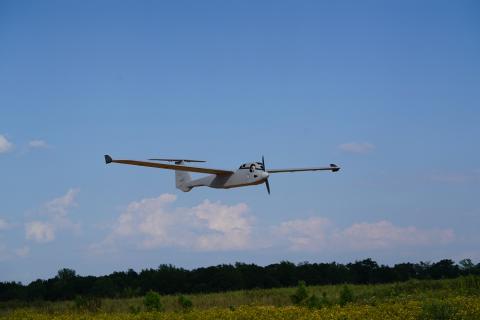
Planck Aero's Shearwater small UAS autonomously takes off and lands onto moving ground vehicle
Marine Corps Air Station (MCAS) Miramar, Air Traffic Control (ATC) recently gave Planck Aerosystems (Planck Aero) permission to test its Shearwater small UAS in controlled airspace and at night.
During testing, the Shearwater small UAS routinely conducted successful autonomous takeoffs and precision landings onto a moving, off-road ground vehicle with centimeter-level accuracy in complete darkness. The UAS performed these tasks without GPS or a pilot in the loop.
According to Planck Aero, the ability to perform nighttime operations from moving vehicles represents a “major step” forward in demonstrating the maturity of the company's vision-based navigation technology.