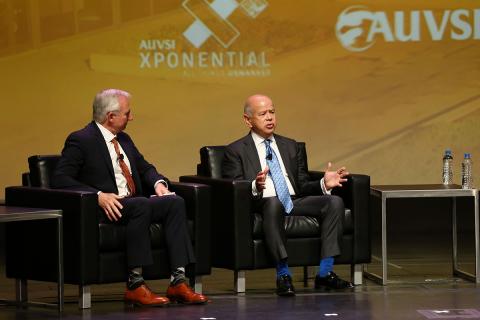
AUVSI has published a 27-page set of comments on the Federal Aviation Administration's Notice of Proposed Rulemaking for remote identification, which would require drones to be able to report their positions, allowing police or other officials to determine who is flying a particular unmanned aircraft.
The issue is seen as enabling the wider use of drones for a variety of services such as package delivery, but the proposed rule has received significant complaints from the hobbyist drone flyers, who say it is too restrictive and would end their hobby. As of the afternoon of March 2, the last day to submit responses, the proposed rule had racked up more than 34,000 comments.
Regulatory
Regulatory
Advanced aerial mobility holds promise, challenges for US aviation leadership, report says
Advanced aerial mobility — including flying taxis and aerial package delivery — gives the United States a unique opportunity to continue its historic leadership in aerospace, says a new report from the National Academy of Sciences, Engineering and Medicine.
In 2018, NASA, which has been a pioneer of urban air mobility, asked the national academy to review the topic. The academy says while the study was underway, NASA and the aviation community began using the term "advanced aerial mobility," of which urban air mobility was the most challenging part.

Sec. Chao releases version 4.0 of federal AV guidelines
Secretary of Transportation Elaine Chao announced the fourth iteration of the federal automated vehicle policy during a keynote speech at CES 2020.
Named Automated Vehicles 4.0: Ensuring American Leadership in Automated Vehicle Technologies, the guidance streamlines federal guidance for 38 government agencies, departments, commissions and others, Chao said, and is aimed at maintaining highway safety while allowing development on AVs to flourish.
"The takeaway from AV 4.0 is that the federal government is all in for safer, better and more inclusive transportation, aided by automated driving systems," she said.

Industry now responding to proposed remote ID rule for drones
The Federal Aviation Administration's proposed rule for the remote identification of drones has now been printed in the Federal Register, giving interested parties 60 days to respond.
AUVSI is reviewing the rules and will be responding, but in the meantime President and CEO Brian Wynne said he welcomes the move.
“The importance of remote ID regulations cannot be overstated, as they are necessary to enable advanced and expanded operations such as flights over people and beyond line of sight," Wynne said.

Task force on drone incursions at airports calls for coordination, federal funding
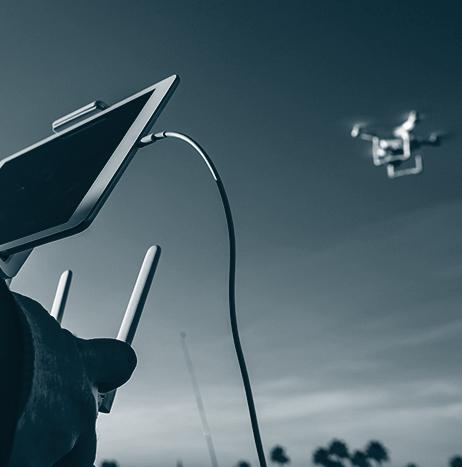
The Blue Ribbon Task Force on UAS Mitigation at Airports, commissioned by AUVSI and the Airports Council International-North America (ACI-NA), released its final report today and recommended that federal governments should work with airports to fight drone incursions and get additional funding to help accomplish that.
The task force also says there is an "urgent need" for the Federal Aviation Administration and Transport Canada to establish drone detection standards and that local law enforcement has a role to play, beginning with a pilot program to demonstrate how that would work.

Speakers highlight importance of Remote ID rulemaking, safe operations during Hill Day
One of the biggest topics of discussion during AUVSI’s annual Hill Day on Wednesday, Sept. 25 was remote identification and the progress, or lack thereof, on this rulemaking.
“This is one issue we’re not going to let up on,” said Rep. Daniel Lipinski.
Like many in the UAS community, Lipinski, who co-chairs the House UAS Caucus, believes the FAA is moving too slow on the rules for remote ID. These sentiments were echoed by Rep. Sam Graves, the ranking member of the House Transportation and Infrastructure Committee.
“I think that has a lot to do with the simple fact that I don’t think they really know which direction they’re going,” Graves said.

From Unmanned Systems Magazine: FAA developing a menu of new rules to oversee the booming unmanned aviation sector
The FAA’s efforts to oversee commercial and recreational unmanned aircraft systems seem to be growing almost as quickly as the industry itself.
With more than 1.4 million UAS now registered with the FAA, a statistic that did not even exist until a few years ago, the agency is pursuing several regulatory and other initiatives to manage the increasing traffic to ensure safe and efficient operations.
“This is a fast-moving industry, and we’re doing our level best to keep up,” then-acting FAA Administrator Daniel Elwell said in a June speech. “The trick is to mitigate safety risks without putting the cuffs on technological and operational advances.”