The Oil & Gas Technology Centre, Total E&P (Total), taurob and the Technische Universitaet Darmstadt (TU Darmstadt) are all working together to develop a robot that could work autonomously alongside humans on a North Sea platform.
Through an 18-month project, which is being described as a “world-first,” the entities will develop and trial a mobile robot for “autonomous operational inspection” of facilities on Total’s onshore Shetland Gas Plant and offshore Alwyn platform.
According to the entities, the trial is the first time that an autonomous ground robot will be used on an operational oil and gas installation, and they believe that the project “could start a revolution in robotics offshore that improves safety, enhances productivity and reduces costs.”
Inspection
Inspection
From Unmanned Systems Magazine: DRONES AND INSURANCE: UNDERSTANDING, AND MITIGATING, THE RISKS OF UNMANNED FLIGHT
In the beginning, man created model aircraft, and they had no cameras. So man created MIL-SPEC manned and unmanned aerial systems with a broad range of image capture and sensing devices. And those were expensive. So man crafted silicon from sand, and from silicon was born digitization, miniaturization, wireless communication, cloud computing, artificial intelligence and a generation of creative technologists. And Gordon Moore declared Moore’s Law, not in that order, and with a few steps in between.
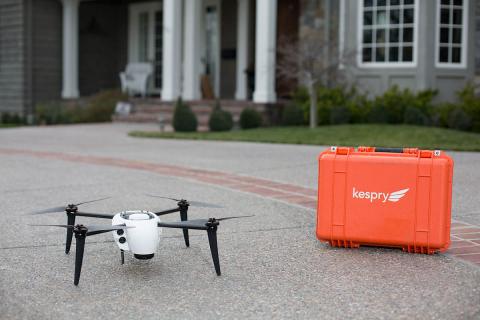
Bihrle and BNSF's 'RailVision' proves beneficial during long range UAS railway inspections
Bihrle Applied Research (Bihrle) and BNSF Railway (BNSF) have announced that they successfully demonstrated the processing of several thousand images at a time, covering hundreds of miles of track for the automatic detection, classification and reporting of rail conditions.
This feat was made possible thanks to RailVision, which is a “computer vision technology solution” developed by the companies in support of BNSF’s UAS research initiatives.
RailVision allows BNSF to automatically process images collected by UAS during supplemental railway inspection flights, and generates actionable reports in a significantly less amount of time required by traditional methods.
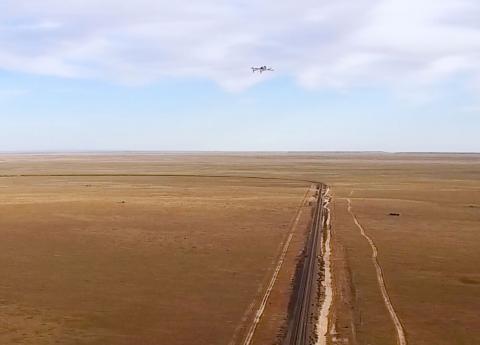
AeroLabs and BGE autonomously inspect distribution assets in Maryland using UAS
In early February, AeroLabs and Baltimore Gas and Electric (BGE) successfully completed a test on the use of a DJI Matrice 210 UAS to perform autonomous inspections of distribution assets in a rural area of northern Maryland.
AeroLabs says that the Matrice “held its own and flew quite well on its programmed flight path” despite flying in adverse conditions, which included strong 15+ mph winds.
The test consisted of a 10-12 pole segment of a circuit that presented various hardware configurations, and tree encroachments that allowed AeroLabs to showcase the UAS' ability to safely maneuver around the assets, and avoid environmental hazards.

V-cube Robotics announces solar power plant inspection package service utilizing UAS
V-cube Robotics, Inc., which is headquartered in Shibuya, Tokyo, has announced that it will begin offering a solar power plant inspection package service that uses UAS called ‘SOLAR CHECK.’
The UAS, which are equipped with infrared thermography cameras, autonomously fly around a facility, imaging the solar panels. These images are then analyzed using artificial intelligence, which, according to VStar, dramatically improves the efficiency of inspection, making it possible to discover discrepancies and report on the results of an inspection in a short amount of time.
Loveland Innovations launches deep learning engine built specifically for UAS-based inspections
A company called Loveland Innovations has announced the launch of the beta version of IMGING Detect, a “deep learning engine built specifically for drone-based inspections.”
Deep learning is an “advanced approach to artificial intelligence (A.I.) that allows IMGING to “learn” as it gathers more data,” Loveland explains, which makes IMGING “more sophisticated and accurate each time it’s used.”
Loveland says that this capability has “vast implications” for a variety of applications such as, but not limited to, damage detection and object and materials detection. Loveland adds that IMGING’s proprietary damage detection algorithms are the “most advanced currently available” to the UAS-based roof, building and property inspection space.
SUEZ partners with Sky Scape Industries to utilize small UAS in North America
SUEZ in North America, which is under Paris-based parent company SUEZ, has partnered with UAS service provider Sky Scape Industries (SSI) in what the companies call an industry first, as they look to implement UAS technology into water utility operations.
SUEZ North America owns and operates 15 water utilities, and operates 70 municipal systems through public-private partnerships and contract partnerships. With this in mind, the companies say that this partnership will “incorporate safe and efficient drone technology solutions into the maintenance and construction of one of the country’s most valuable utilities.”
Using UAV Imagery and Deep Learning for Wind Turbine Inspection
When it comes to using a UAV to collect imagery for wind turbine inspections, maneuvering a drone around a huge turbine isn’t the only challenge involved. There’s also the issue of capturing extra positional information so images can be projected onto a plane, which is necessary since the camera is not positioned to look directly down as in most UAV imagery applications. Then there’s ensuring the quality of the capture while in the field to avoid the costs associated with having to re-fly a job. Finally, there is the time and rigor required to analyze all that data to identify and locate damage and other abnormalities on turbine blades.
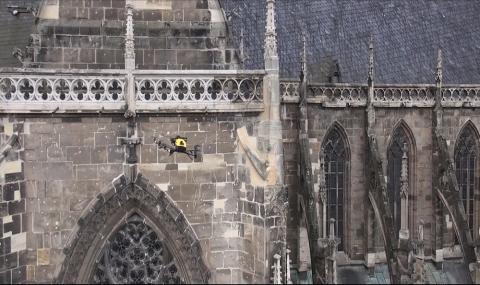
Intel uses its Falcon 8+ UAS to help preserve cathedral in Germany
Intel’s Falcon 8+ UAS is being used to help preserve the 15th century Halberstadt Cathedral in Saxony-Anhalt, Germany.
Recently, the UAS was used to capture nearly 1,000 detailed images—along with additional footage—in less than an hour of total flight time.
That data was post-processed to create precise 3-D structural models for Intel and its partners on the project, experts from Bauhaus University Weimar and Kulturstiftung Sachsen-Anhalt, to analyze.
The Falcon 8+ UAS is providing the conservation team with a new, affordable way of conducting a visual inspection of structures that are fragile and hard-to-reach.
Washington's Walla Walla County introduces UAS
According to the Union-Bulletin, UAS will now be a part of the operations of Walla Walla County, Washington.
In its debut, the county's new UAS, which is constructed mostly of “high-tech Styrofoam” and has a wingspan of approximately five feet, was used to perform an aerial survey of Whitman Drive for a planned bike-pedestrian pathway.