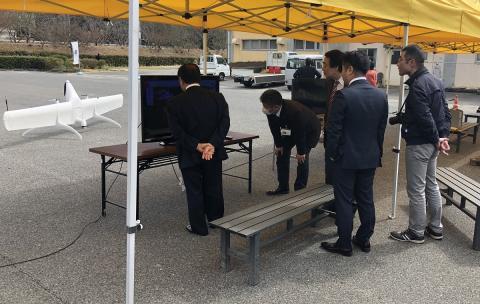
As part of a contract with Okayama Prefecture in Japan, teams from Swift Tactical Systems, in collaboration with the company’s Japanese counterpart, Swift-Xi, recently validated Swift’s UAS and capabilities under unique scenarios when they completed personnel search and rescue and animal identification missions as part of a proof of concept program.
Swift’s ability to perform advanced search and rescue missions in dense forests was validated, as well as the system’s ability to quickly detect, identify, and track the nighttime movements of animals that are destructive to the region.
Testing
Testing
DroneUp, partners test how UAS could help medical professionals battling COVID-19
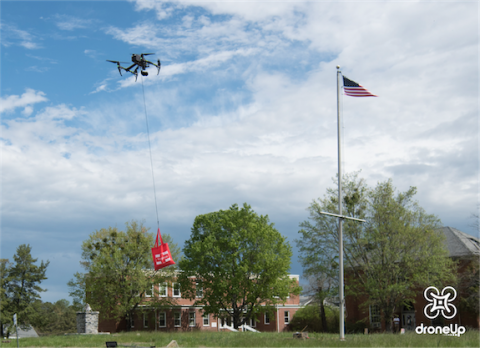
To determine how UAS could help medical professionals in their fight to stop the spread of the Coronavirus, DroneUp, UPS and its subsidiary UPS Flight Forward (UPSFF), Virginia’s Center for Innovative Technology (CIT), and Workhorse Group recently came together to test the technology in Lawrenceville, Virginia.
The entities say that experts in the healthcare industry and in government are looking for technology that could speed the pace of testing and treatment for infected patients, making autonomous drones a potentially valuable tool. The tests evaluated the commercial drone industry’s ability to provide and scale small UAS to support a variety of use cases to speed and assist the U.S. healthcare system during the pandemic.
Weekend Roundup: April 17, 2020
This Week in the Unmanned Systems and Robotics World
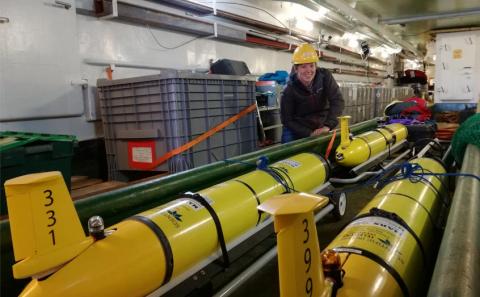
Oceanographers from the Scottish Association for Marine Science (SAMS) recently uncovered a hidden Arctic eddy using an autonomous glider. Eddies are circular movements of water that have broken off from an ocean current. (Scottish Association for Marine Science)
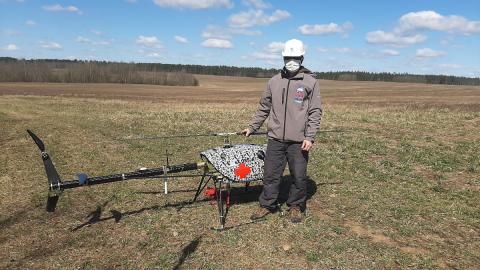
UAVOS successfully tests cargo delivery UVH-170 unmanned helicopter
During a trial designed to validate a highly automated delivery flight from a vendor to a destination and back, across precisely pre-selected pathways, UAVOS successfully tested its cargo delivery UVH-170 unmanned helicopter.
During the 1.7-hour flight that covered a standoff distance of 62 miles, critical humanitarian aid that weighed 17.6 pounds was delivered without the UAS having to land, and without the need for a ground control station on the receiving side.
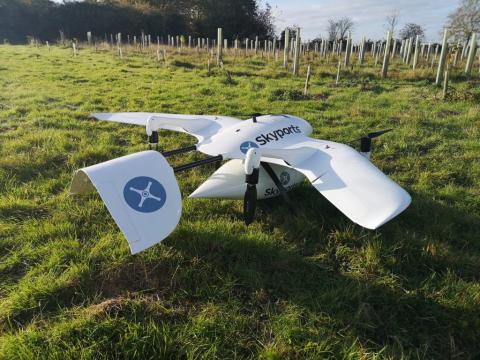
Skyports to trial BVLOS flights in non-segregated airspace after joining UK CAA Regulatory Sandbox
After being accepted into the UK Civil Aviation Authority’s (CAA) Regulatory Sandbox, drone delivery service provider Skyports will begin testing beyond visual line of sight (BVLOS) flights in non-segregated airspace.
Specializing in operating end-to-end drone deliveries within the medical, e-commerce and logistics sectors, Skyports, along with the UK CAA, will explore how drones controlled out-of-sight of the remote pilot can be granted regulatory approvals to fly safely within airspace that is shared with other aircraft, which will be crucial for permanent drone deliveries to become a reality.
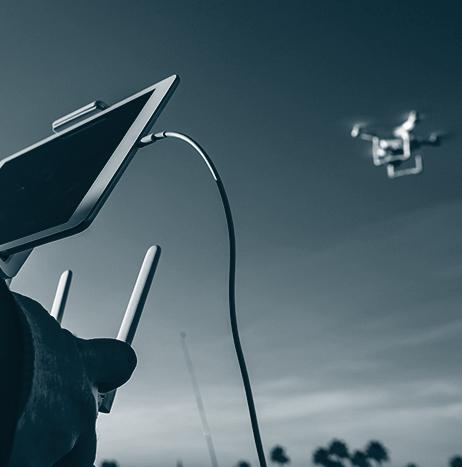
FAA announces two new participants for unmanned aircraft Traffic Management Pilot Program
The FAA’s NextGen program has selected Virginia Tech Mid-Atlantic Aviation Partnership in Blacksburg, Virginia, and Griffiss International Airport in Rome, New York as test site participants for Phase 2 of the unmanned aircraft Traffic Management Pilot Program (UPP).
UPP Phase 1, which was a collaborative effort between NASA, FAA UAS test sites and their industry partners, was completed in Aug. 2019. Capabilities tested during Phase 1 included the exchange of flight intent data among UAS operators. Participants also generated UAS Volume Reservations (UVRs), which are notifications to operators about inbound priority operations.
Weekend Roundup: April 10, 2020
This Week in the Unmanned Systems and Robotics World
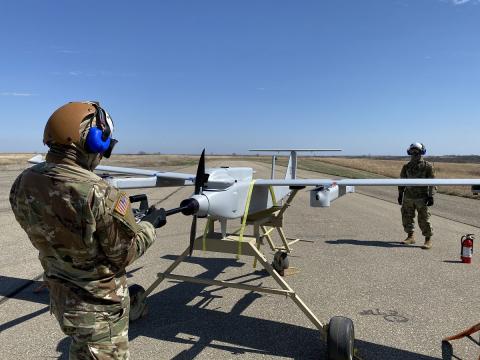
On April 7, the Arcturus UAV JUMP 20 underwent its first soldier-operated flight in a capabilities assessment. Arcturus is the first candidate in the running to replace the Army’s RQ-7 Shadow UAS. (Defense News)
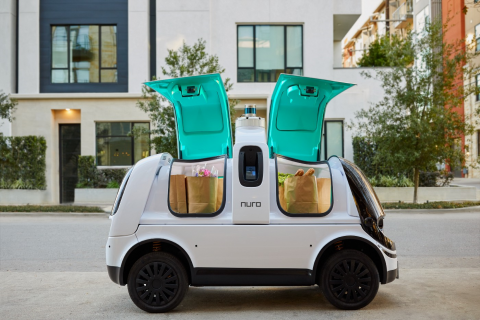
Nuro granted permit to test driverless, passengerless vehicles on public roads in California
The State of California has granted Nuro the first permit ever to test a self-driving vehicle on public roads that is both driverless and passengerless.
Only the second driverless testing permit California has granted to any company—Waymo received the first in 2018—the permit allows Nuro to begin testing its R2 vehicle in service with its partners, starting in the Silicon Valley region.
“California is Nuro’s home, and we are excited to bring our neighborhood-friendly R2 vehicle into our communities, in close cooperation with the DMV, local leaders, and law enforcement,” Nuro says.
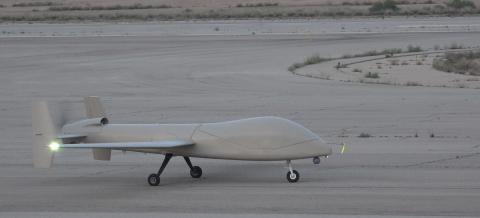
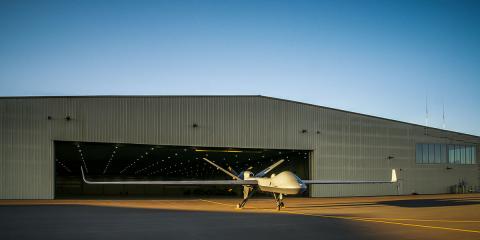
GA-ASI's first production-representative MQ-9B SkyGuardian completes first flight
General Atomics Aeronautical Systems Inc. (GA-ASI) has announced the completion of the first production-representative MQ-9B SkyGuardian Remotely Piloted Aircraft (RPA).
The aircraft completed its first flight on March 30 at GA-ASI’s Flight Operations Facility in El Mirage, California.
“With first flight of the production-representative aircraft, we remain on schedule for delivering MQ-9B Protector to the RAF,” says Linden Blue, CEO, GA-ASI.
Protector RG Mk1 is being acquired for the UK Royal Air Force’s configuration of SkyGuardian.
UAVOS, KACST successfully demonstrate flight control system capability for Saker MALE UAS family
In collaboration with King Abdulaziz City for Science and Technology (KACST), Saudi Arabia, UAVOS has developed and demonstrated a progressive flight control system capability for the Saker MALE UAS family.
The Saker-1B UAS has been flown under remote control with no need for a ground control station at the takeoff or landing site. When equipped with the flight control system capability, the UAS can automatically land in remote runways located thousands of kilometers away where a crew services it before it takes off for another mission.