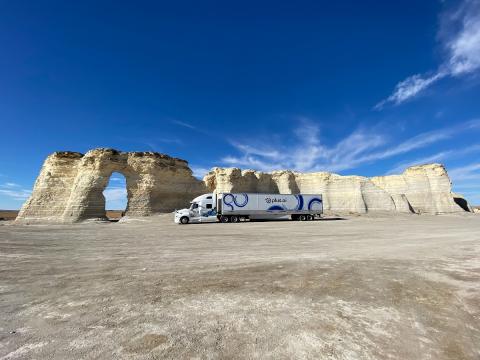
Self-driving truck technology company Plus.ai has announced that it successfully completed the first coast-to-coast commercial freight run with an autonomous truck on behalf of Land O’Lakes Inc.
Considered the first L4 U.S. cross-country commercial pilot, the hub-to-hub trip covered 2,800 miles from Tulare, California to Quakertown, Pennsylvania in less than three days, hauling a fully-loaded refrigerated trailer of perishable cargo.
Testing
Testing
UAV Turbines demonstrates Monarch Hybrid Range Extender for electrically powered medium-sized UAS
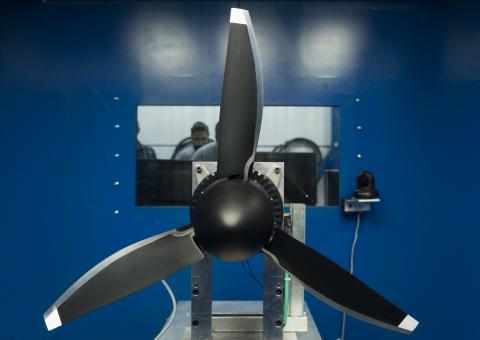
Microturbine technology developer UAV Turbines Inc. (UAVT) has announced the successful demonstration of its Monarch Hybrid Range Extender (HREX), which the company describes as a microturbine powered generator technology that extends the range of electrically powered medium-sized UAS.
With the HREX developmental system, the range of a number of different electrically powered UAS now in development can be extended, while at the same time providing the proven reliability of a gas turbine system.
Robotic Research granted permission to operate Olli autonomous shuttle in Maryland
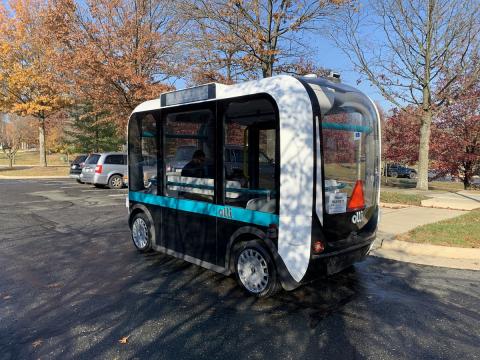
The Maryland Department of Transportation (MDOT) Motor Vehicle Administration recently granted autonomy and robotic technologies provider Robotic Research LLC permission to operate Local Motors’ Olli autonomous shuttle between its two office locations in Clarksburg, Maryland.
The Olli shuttle is driven by Robotic Research’s AutoDrive technology.
After a thorough review of the technology with Montgomery County government, law enforcement, fire/EMS, and public transportation, MDOT granted Robotic Research a Highly-Automated Vehicle (HAV) permit for the Olli shuttle, which will allow the company to continue its research and testing of autonomous vehicle capabilities and technology directly on a half-mile stretch of public roadway in Montgomery County.
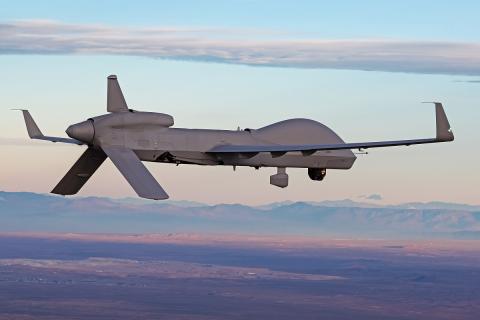
Gray Eagle ER UAS performs flight demonstration using Dynetics GBU-69B Small Glide Munition
General Atomics Aeronautical Systems Inc. (GA-ASI) has announced that from Aug. 21 to 22, a U.S. Army MQ-1C ER Gray Eagle Extended Range (GE-ER) UAS performed a flight demonstration using a Dynetics GBU-69B Small Glide Munition (SGM), which is a lightweight munition with increased effective range.
The demonstration was a collaborative effort between GA-ASI, the U.S. Army and Dynetics.
“The GE-ER operates at an altitude that provides an advantage when using stand-off munitions,” says David R. Alexander, president, GA-ASI.
“The reduced weight of the SGM allows the UAS to carry more munitions per aircraft.”
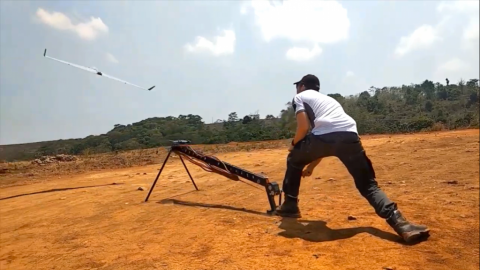
Terra Drone Indonesia showcases the advantages of using UAS for pipeline monitoring
Terra Drone Indonesia, a group company of Terra Drone Corporation, recently showcased the advantages of using UAS for pipeline monitoring during a demonstration for Indonesian oil and gas group Medco Energi Internasional Tbk PT in Purwakarta, West Java.
The Terra BRAMOR C4EYE UAS, manufactured by Terra Drone group company C-Astral, was used during the demonstration.
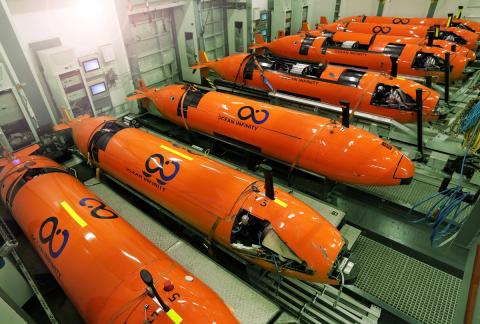
Ocean Infinity tests battery technology for AUVs
Following 18 months of research, development and trials, Ocean Infinity has tested new, advanced battery technology for AUVs.
Ocean Infinity says that its new 6000 meter pressure tolerant batteries provide the company’s HUGIN AUVs with greater endurance and efficiency, allowing missions to be conducted across a period of more than four days without having to change the battery.
In combination with Ocean Infinity’s multi-AUV operation, the technology also increases the possible survey range to nearly 700 kilometers per AUV, providing the industry with a “revolutionary survey platform offering,” according to the company.
Airbus Helicopters' VSR700 UAS flies for the first time
On Friday, Nov. 8, Airbus Helicopters’ VSR700 UAS prototype performed its first flight at a drone test center near Aix-en-Provence in the south of France.
The UAS performed several take-offs and landings, with its longest flight lasting approximately 10 minutes.
The VSR700 UAS was tethered with 30-meter cables to fully secure the flight test zone, so that it was in compliance with airworthiness authority that provided the flight clearance. Going forward, the flight test program will move towards free flight, with plans to progressively open the flight envelope.

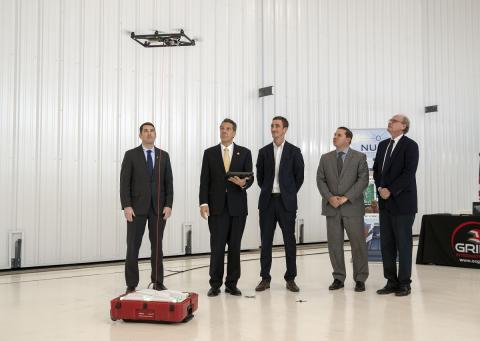
New York Gov. Cuomo announces completion of 50-mile drone corridor
New York Gov. Andrew M. Cuomo has announced the completion of New York’s 50-mile unmanned traffic management (UTM) drone corridor, which runs from Central New York to the Mohawk Valley.
Considered the first of its kind in the nation, the corridor will provide companies with the space to test UAS and UTM technologies in real world settings to collect data that will help inform the industry and regulators, and push society towards regular commercial drone use.
MIT engineers develop technique that allows robots to find front door without having to map an area in advance
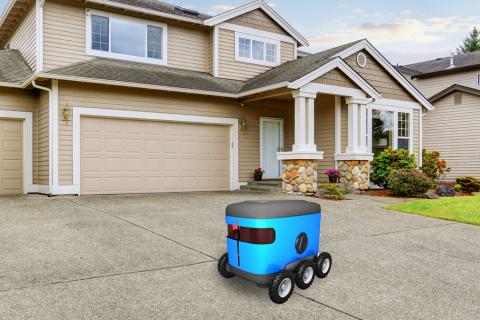
MIT engineers have developed a navigation method that helps last-mile delivery vehicles find the front door without having to map an area in advance.
With the approach developed by MIT engineers, a robot would use clues in its environment to plan out a route to its destination, which wouldn't be described as coordinates on a map, but instead could be described in general semantic terms such as “front door” or “garage.”
So in instances where a robot is charged with the task of delivering a package to someone's front door, it wouldn’t take the robot long to explore the property before identifying its target. The robot also wouldn’t have to rely on maps of specific residences.
UAVOS completes test flight of modified ApusDuo solar-powered high-altitude platform system
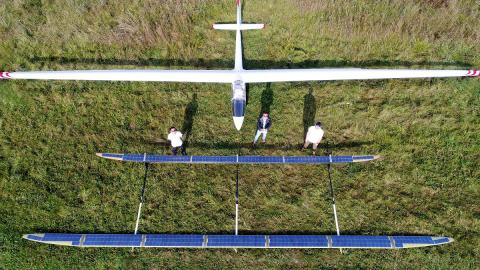
UAVOS has successfully completed a test flight of the new modification of its ApusDuo solar-powered high-altitude platform system (HAPS), which has a wingspan of 14 meters.
The reliability of HAPS increased while the aircraft’s overall structural weight decreased thanks to the modifications to the design of the main elements of the aircraft.
“UAVOS demonstrated a flight of ApusDuo aircraft with a wingspan of 9000m in August 2018,” says UAVOS CEO Aliaksei Stratsilatau.
“Following lower-altitude test flights and other preoperational activities, currently we coordinate with the Air Traffic control getting permit to perform stratospheric test flights.”