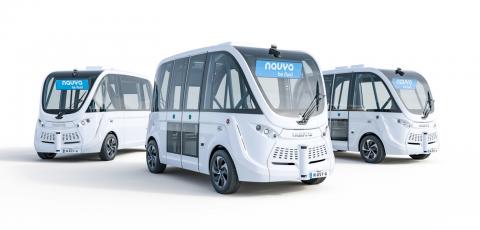
Velodyne Lidar Inc. recently announced a multi-year sales agreement with autonomous vehicle developer NAVYA.
Since 2015, NAVYA has been equipping its autonomous shuttles with Velodyne lidar sensors. Featuring optimized navigation and safety features, NAVYA’s autonomous shuttles offer first and last mile transportation options in cities and at private sites.
“NAVYA is at the forefront of inventing and growing the autonomous shuttle business, providing an innovative, clean mobility solution,” says Anand Gopalan, CEO, Velodyne Lidar.
Sensors
Sensors
Peraton wins spot on contract to support U.S. Navy's Unmanned Surface Vehicle Family of Systems
Unmanned maritime systems contractor Peraton has announced that it has won a spot on an up to 10-year, $982.1 million indefinite-delivery/indefinite-quantity, multiple award contract (IDIQ-MAC) to support the U.S. Navy's Unmanned Surface Vehicle Family of Systems.
Just last month, Peraton announced that it recently received four U.S. Navy Unmanned Maritime Systems Support (UMSS) task orders valued at $27.45M.
Peraton's work with the U.S. Navy on unmanned maritime systems dates back to 2001 when it first supported the Navy's program management office responsible for explosive ordinance disposal.

MIT researchers enables soft robotic arm to understand its configuration in 3D space using "sensorized" skin
MIT has announced that for the first time, its researchers have leveraged just motion and position data from the “sensorized” skin of a soft robotic arm to enable it to understand its configuration in 3D space.
MIT notes that soft robots made from highly compliant materials—similar to those found in living organisms—are being championed as safer, and more adaptable, resilient, and bioinspired alternatives to traditional rigid robots. Giving these deformable robots autonomous control is considered a “monumental task,” though, because at any given moment, they can move in a virtually infinite number of directions, which makes it hard to train planning and control models that drive automation.
Persistent Systems to develop Protected Communications for Manned-Unmanned Teams for U.S. Army
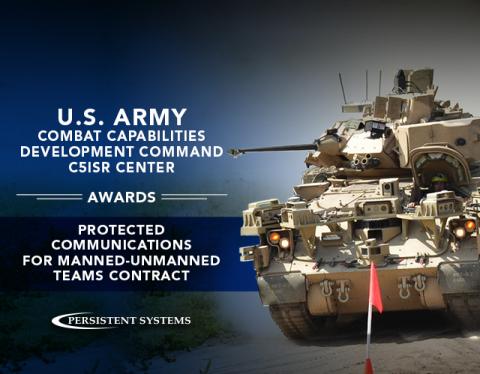
The U.S. Army Combat Capabilities Development Command C5ISR Center has awarded Persistent Systems LLC a $5.4M contract to develop Protected Communications for Manned-Unmanned Teams (MUM-T).
The Army has a vision for a next-generation Optionally Manned Fighting Vehicle (OMFV) that can be networked with up to four unmanned Remote Combat Vehicles (RCVs) and their assorted sensor/weapons payloads. The vehicle would also be networked with the broader force and command structure.
In order to make these manned-unmanned teams a reality, they will need a robust, secure, and high-throughput communications network, which is where Persistent Systems comes in.
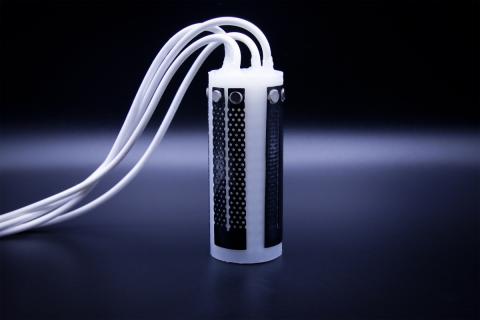
RoboSense LiDAR and the future of self-driving cars
To achieve large-scale commercialization of autonomous vehicles, a new generation of high-precision 3D environment sensing solid-state LiDAR technology products will be required to fulfill the industry’s strict requirements.
Q&A with Dr. Leilei Shinohara, VP of R&D

Echodyne introduces high-resolution imaging radar for autonomous vehicles
Echodyne has introduced EchoDrive, the company’s high-resolution imaging radar for autonomous vehicles.
Built on MESA technology, EchoDrive offers a new type of sensor functionality that greatly enhances machine perception, Echodyne says. The company adds that EchoDrive delivers what it describes as “unprecedented real-time control” over the radar’s interrogation of the drive scene, which enables a “richer form” of machine perception.
Mikros Systems awarded SBIR Phase I contract to develop software for USVs and UUVs
The Naval Sea Systems Command has awarded advanced technology company Mikros Systems Corporation a $150,000 Small Business Innovation Research (SBIR) Phase I contract for topic number N193‑A02: “Unmanned Surface Vehicle (USV) and Unmanned Underwater Vehicle (UUV) Autonomous Behavior Development.”
Through this contract, Mikros Systems will develop a Sensor In-stride Diagnostic, Correction, and Confidence Component (SID3C) that can be installed on current and future USV and UUV vehicle platforms. SID3C will monitor shipboard sensors and sensor data to detect degradation or failures and correct recoverable sensors. The component will also help autonomy systems appropriately filter unreliable sensor data.
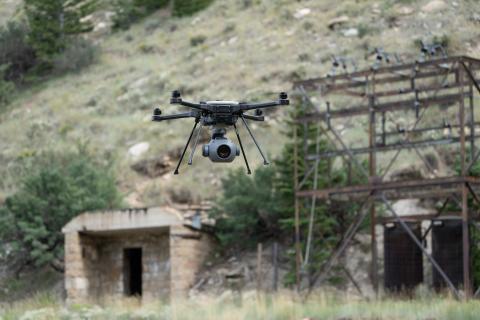
FLIR Systems unveils FLIR StormCaster family of UAS payloads for its UAS
FLIR Systems Inc. has introduced the FLIR StormCaster family of UAS payloads for the company’s SkyRanger R70 and R80D SkyRaider UAS.
According to FLIR, the new line launches with two multi-sensor products, the StormCaster-T and StormCaster-L. The StormCaster-T delivers continuous zoom and longwave infrared (LWIR) imaging, while the StormCaster-L provides ultra-low-light imaging, tracking, and mapping.
MIT helps automated vehicles see around corners
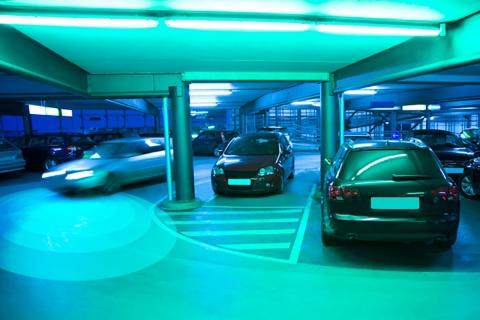
MIT researchers have developed a system that can sense tiny changes in shadows on the ground to help autonomous systems determine if a moving object is coming around a corner.
This work, funded by the Toyota Research Institute, could one day help keep self-driving cars from hitting other cars or pedestrians or help guide robots through hospital hallways as they deliver medicine or supplies.
MIT researchers conducted experiments with an autonomous vehicle driving around a parking garage and a self-driving wheelchair moving through hallways. in a paper presented at the International Conference on Intelligent Robots and Systems, they said the new system bested traditional lidar systems by more than half a second — not a lot, but enough to forestall accidents.
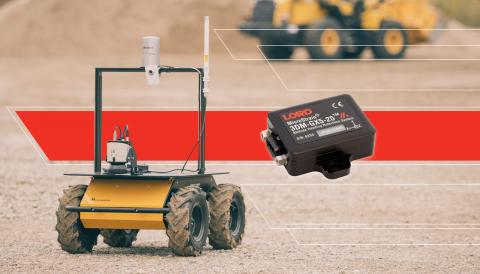
LORD equipping Clearpath research robot platform with inertial sensors through new partnership
LORD Corp. has partnered with Clearpath Robotics to equip the Clearpath research robot platform with LORD’s inertial sensors.
LORD inertial sensors enhance the autonomous capabilities of Clearpath’s robots, helping provide them with precise navigation in applications such as 3-D mapping in difficult terrain.