Huntington Ingalls Industries (HII) is expanding its unmanned systems capabilities with a highly skilled team and proven USV solutions through its acquisition of the autonomy business of Spatial Integrated Systems Inc. (SIS), which HII announced on Monday, Jan. 4.
The transaction closed on Dec. 31, 2020 and approximately 50 employees from SIS, primarily located in Virginia Beach, Virginia, have joined HII Technical Solutions’ Unmanned Systems business group. HII broke ground on its new HII Unmanned Systems Center of Excellence in nearby Hampton, Virginia in Sept. 2020.
Sensors
Sensors

Weekend Roundup: December 18, 2020
This week in the Unmanned Systems and Robotics World
Skydio has announced the general availability of a broad set of advanced AI-pilot assistance capabilities for enterprise and public sector operators called Skydio Autonomy Enterprise Foundation (AEF). According to Skydio, AEF optimizes the Skydio 2 drone for professional use in a wide range of missions, including outdoor/indoor inspections, search and rescue, emergency response, security patrol, and situational awareness. (Skydio)

Weekend Roundup: December 4, 2020
This week (and last) in the Unmanned Systems and Robotics World
Mississippi State University (MSU) engineers in the university’s Raspet Flight Research Laboratory are leading research efforts that could make UAS operational by the U.S. government, as well as civilian aviation, in icy conditions. The U.S. Department of Defense is hoping that the icing system development and technology team being led by MSU will result in lightweight anti-icing systems, which would lead to certification for UAS to operate in forecasted icing conditions. (Mississippi State University)
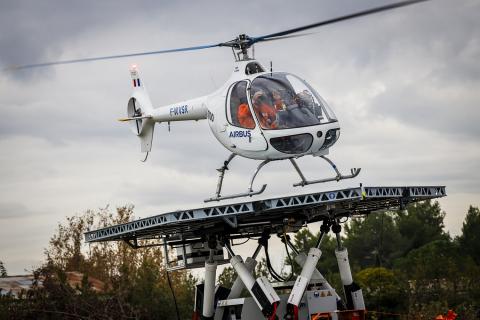
Velodyne Lidar, Ford Otosan collaborating to develop and test autonomous heavy commercial trucks
Velodyne Lidar and Ford Otosan will work together on product development and testing of autonomous heavy commercial trucks.
To enable safe navigation and collision avoidance in next generation vehicles, Ford Otosan is testing and planning to use Velodyne Velarray H800 lidar sensors, which are described as a “powerful solution that can greatly improve automated safety and advanced driver assistance systems (ADAS).”
“Autonomous vehicle technology, powered by lidar, can bring multiple efficiency and safety benefits to the trucking industry,” says Burak Gökçelik, assistant general manager, Ford Otosan.

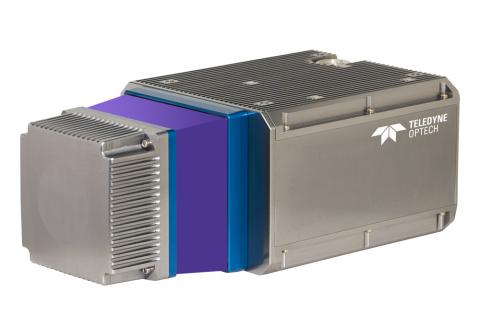
Teledyne Optech's CL-360 serves as building block for next gen, best-in-class UAVs
Teledyne Optech’s CL-360 is a survey grade 360-degree laser scanner that enables OEM hardware manufacturers and integrators to develop the next generation of best-in-class UAV, mobile, and terrestrial scanning solutions for various surveying applications.
Being a survey grade lidar scanner means that the resulting 3D points derived from the CL-360 are suitable for applications such as surveying or inspections. More specifically, the accuracy and precision (repeatability) of the points is greater than those obtained by lower performance lidar sensors or other methods such as photogrammetry, according to Mark Treiber, Product Manager, Compact Lidar.
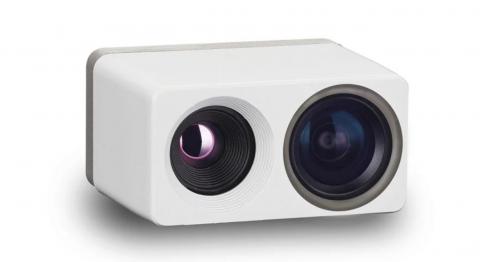
FLIR Systems introduces FLIR Hadron for drone, robotic and imaging OEMs
FLIR Systems has introduced the industry’s first dual sensor module for drone, robotic, and imaging original equipment manufacturers (OEMs), FLIR Hadron.
Described as lightweight and low power, the compact form factor includes a 12-megapixel visible camera paired with the FLIR Boson 320x240 resolution thermal camera with up to a 60-hertz framerate. FLIR says that FLIR Hadron is designed to help reduce development costs and improve time-to-market.
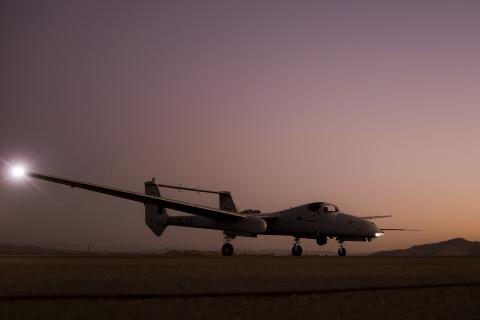
Northrop Grumman's Firebird demonstrates multi-mission capabilities during recent exercise
Northrop Grumman has announced that it recently completed a series of mission focused engagements, including integration and testing of Overwatch Imaging’s TK-9 Earthwatch sensor on its Firebird system.
A provider of automated airborne imaging systems for piloted and unmanned aircraft, Overwatch Imaging's TK-9 Earthwatch sensor is equipped with a flexible onboard AI-enabled automatic image processing engine that allows the system to quickly adapt to new roles in new environments such as natural disaster emergency management, border security patrol, or large-scale infrastructure inspection.
Attollo Engineering introduces Phoenix shortwave infrared camera
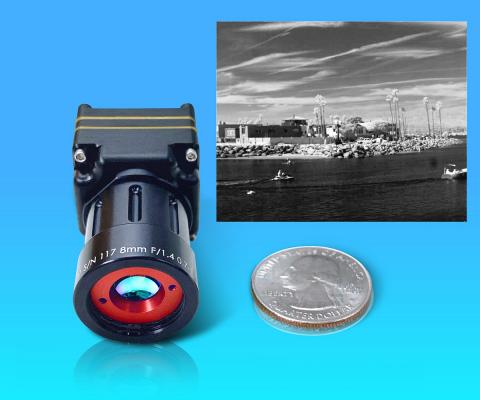
Global engineering expert and infrared imaging technologies supplier Attollo Engineering has introduced the Phoenix, which is a 640 x 512 shortwave infrared (SWIR) camera with the industry’s smallest VGA sensor and an extremely small 5 µm pixel pitch.
Described as “revolutionary,” the cost-efficient and miniature sensor is ideally suited for broadband imaging, as well as daylight and nighttime laser see-spot and range-gated imaging.
CU Boulder engineer designing artificial limbs that restore sense of touch for amputees
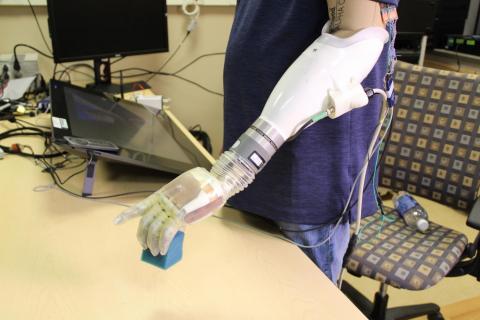
University of Colorado Boulder (CU Boulder) biomedical engineer Jacob Segil is working to restore the sense of touch for amputees, including veterans of the wars in Iraq and Afghanistan.
An instructor in the Engineering Plus Program and program director for the Center for Translational Research at CU Boulder, Segil is designing artificial limbs that may one day allow amputees to feel the world around them through electronic sensors.
“In my field, we have a gold standard, which is the physiological hand,” Segil says. “We’re trying to recreate it, and we’re still so far off.”
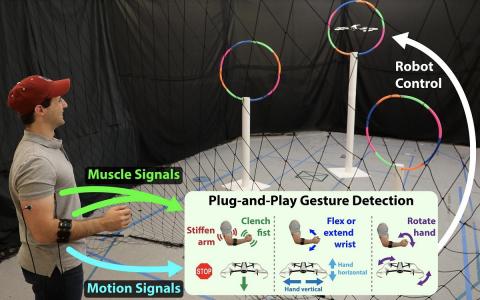
MIT's 'Conduct-A-Bot' uses human muscle signals to pilot a robot's movement
A team from MIT’s Computer Science and Artificial Intelligence Laboratory (CSAIL) has developed a system called “Conduct-A-Bot,” which pilots a robot’s movement using human muscle signals from wearable sensors.
The team says that Conduct-A-Bot could potentially be used for various scenarios, including navigating menus on electronic devices or supervising autonomous robots.
“We envision a world in which machines help people with cognitive and physical work, and to do so, they adapt to people rather than the other way around,” explains Daniela Rus, MIT professor and director of CSAIL, and co-author on a paper about the system.