Defense
Defense
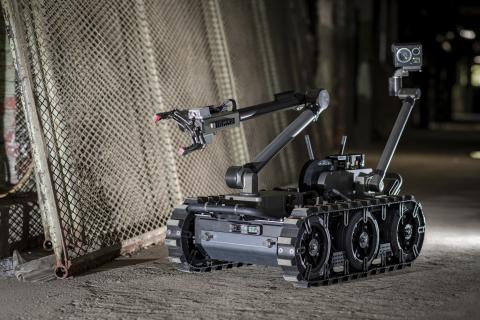
U.S. Army and Navy order more than 160 of FLIR Systems' Centaur UGVs
The U.S. Army and Navy have ordered more than 160 of FLIR Systems’ Centaur UGVs, plus related spares and accessories.
Totaling $23.5 million, the two contracts are being sourced through the Army’s Man Transportable Robotic System Increment II (MTRS Inc II) program. Deliveries are expected to begin in the third quarter of 2020.
“With the Navy joining the MTRS Inc II program, it means that all U.S. military forces will now use a common, medium-sized robotic platform for EOD and CBRN operations,” says Roger Wells, VP and general manager of the Unmanned Systems & Integrated Solutions business at FLIR.

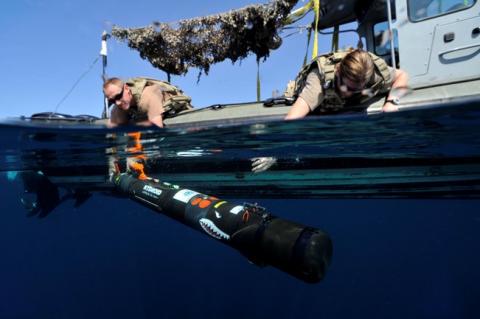
SeeByte to provide a variety of services for MK18 UUV Family of Systems
The US Naval Surface Warfare Center (NSWC) Indian Head EOD Technology Division has awarded SeeByte the first delivery order in the second option year of a five-year contract, which will result in SeeByte providing engineering, technical support, and training services for the MK18 UUV Family of Systems (FoS).
“We are delighted to continue our support in response to MK18 training needs. We will provide a tailored training solution which will encompass the mission planning, mission monitoring and post-mission analysis features of our multi-vehicle co-operative autonomy product, Neptune,” says Rob Carsley, operations manager at SeeByte.
The dos and don'ts of the Defense Production Act: How manufacturers can take advantage
In the current uncertain business environment, manufacturing demand has visibly shifted — ventilators, masks and other key items are needed in vast quantities and at short notice.
As a manufacturer you want to keep producing, and the government’s Defense Production Act could enable manufacturing organizations to alter production to cater for the new demand.
Matt Medley, Senior Product Manager at IFS, an enterprise software company, explains how the act works and how it can benefit your organization if you are agile enough.

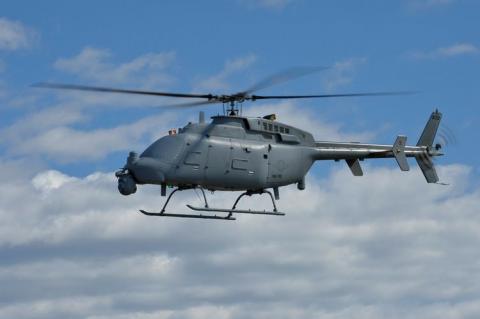
U.S. Navy, Northrop Grumman begin flight testing MQ-8C Fire Scout equipped with AN/ZPY-8 radar
Northrop Grumman and the U.S. Navy recently began flight testing of the MQ-8C Fire Scout UAS equipped with the Leonardo AN/ZPY-8 radar.
The Fire Scout’s first flight with the radar took place on Feb. 27 at Webster Outlying Field. Before that flight, several weeks of ground tests were conducted. As the entities consider mission expansion opportunities for the UAS, testing will continue to progress.
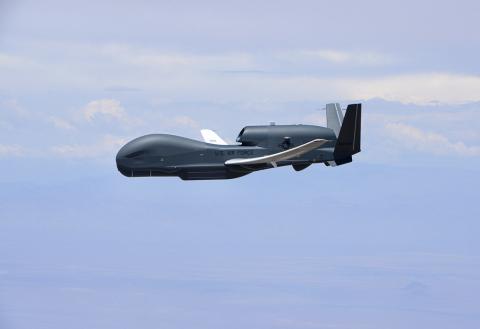
Report calls for using HALE drones for 'deterrence by detection' military strategy
According to a new study by Washington's Center for Strategic and Budgetary Assessments (CSBA), the fleet of high-flying, long-endurance unmanned aircraft operated by the United States and its allies could be a vital hedge against efforts by Russia and China to expand their borders and influence.
The report, "Deterrence by Detection: A Key Role for Unmanned Aircraft Systems in Great Power Detection," says Russia and China can conduct rapid strikes on neighboring countries on their peripheries, often before the United States or its allies could react.
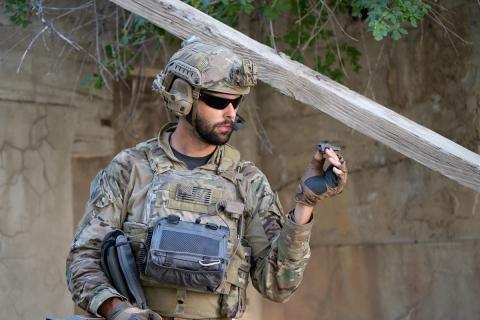
FLIR Systems wins contract from U.S. Army to deliver its FLIR Black Hornet 3 PRS
FLIR Systems Inc. has won an additional $20.6 million contract from the U.S. Army to deliver its FLIR Black Hornet 3 Personal Reconnaissance Systems (PRS).
As part of the Army’s Soldier Borne Sensor (SBS) program, FLIR's advanced nano-UAS will support platoon- and small unit-level surveillance and reconnaissance capabilities.
“Black Hornet has proven to be a game-changing technology – a small package that can deliver a big edge on the battlefield,” says VP and General Manager of the Unmanned Systems & Integrated Solutions business line at FLIR, Roger Wells.
Black Swift Technologies to develop UAS for Air Force, Army and Special Operations Forces ops
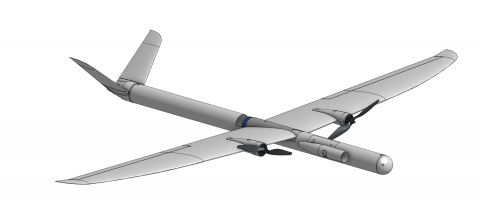
Black Swift Technologies (BST) has been awarded a USAF SBIR Phase II contract to develop a UAS that can autonomously conduct atmospheric profiling to support more accurate cargo drops and improved localized weather forecasts in support of Air Force, Army and Special Operations Forces (SOF) operations.
Known as the Black Swift SØ (S-zero), the compact, rugged aerial platform is designed to be hand-launched with the ability to quickly climb up to 15,000 feet. It is capable of a deep-stall landing with near vertical descent and 10-foot accuracy thanks to its unique tail design. Its rapid ascent and descent capabilities allow the UAS to quickly and accurately capture 3-dimensional (3D) wind profiles at a variety of levels, which is crucial for precision cargo drops.
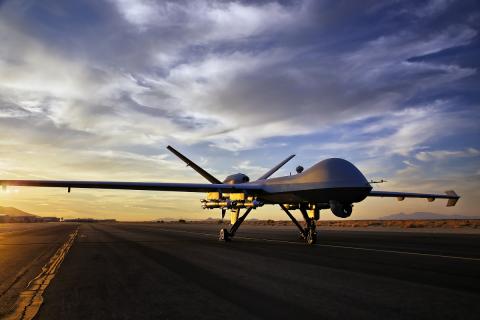
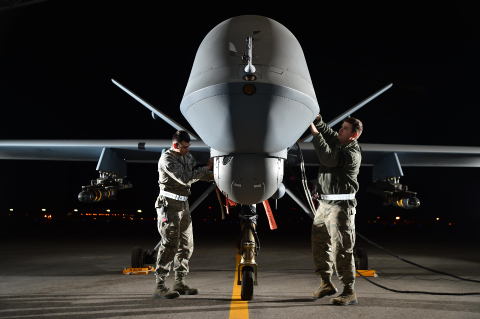
USMC conducts first operational flight of MQ-9A Reaper UAS in the Middle East
U.S. Marine Corps (USMC) pilots and sensor operators from Marine Unmanned Aerial Vehicle Squadron 1 (VMU-1) conducted their first operational flight of GA-ASI's MQ-9A Reaper UAS in the Middle East on March 20.
The VMU-1 “Watchdog” crews took control of a Company Owned/Company Operated (COCO) MQ-9A supporting forward deployed Marines, while the GA-ASI team provided oversight.
This achievement by the USMC comes shortly after 7,000 hours of COCO flight operations since Sept. 2018 was surpassed.
“This achievement represents a unique milestone and example of the Marine Corps’ legacy of innovation,” says David R. Alexander, president, GA-ASI.