
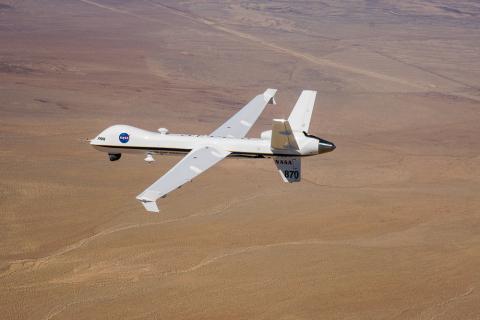
A General Atomics Aeronautical Systems Inc. (GA-ASI) developed Detect and Avoid (DAA) avionics system was the “key technology” that enabled a UAS flight through the National Airspace System (NAS) on June 12.
The DAA system, which was installed on a NASA-owned Predator B/MQ-9 UAS named Ikhana, allowed the UAS to meet the FAA’s 14 CFR 91.113(b) requirement to “see and avoid” other aircraft during its flight. The UAS took off from southern California.
“Our goal of producing UAS that can be certified to fly in non-segregated airspace took a big step forward today,” says Linden Blue, CEO, GA-ASI.
Components
Components
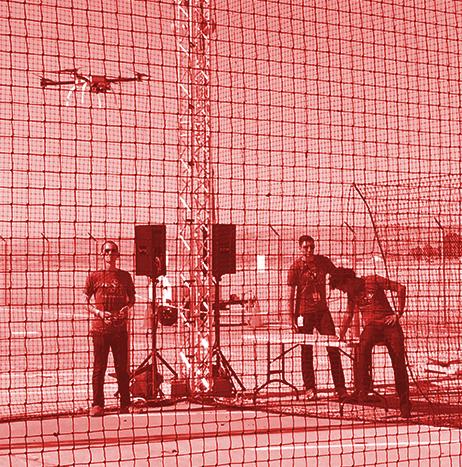
Mohawk Valley Community College receives grant that will help prepare students for UAS industry
The National Science Foundation has awarded Mohawk Valley Community College (MVCC) a $557,487 grant to support a project in which MVCC will develop a series of “microcredentials” to increase the number of skilled technicians in the UAS industry, and ultimately address local workforce needs.
Over the next three years, MVCC will develop and implement five microcredentials made up of four courses each, which will provide students with “highly specialized, specific skills” without requiring completion of a full degree. The microcredentials are UAS Components, UAS Fabrication, UAS Operations, UAS Electronics, and UAS Data Analysis.
AlarisPro UAS fleet management software benefits from customer input
After being asked to help a UAS manufacturer propose their system to the Department of Defense, Tony “Pooch” Pucciarella, founder of AlarisPro, says he was surprised to learn that the company was unfamiliar with standard aviation reliability and safety metrics such as mean time between replacement and failure.
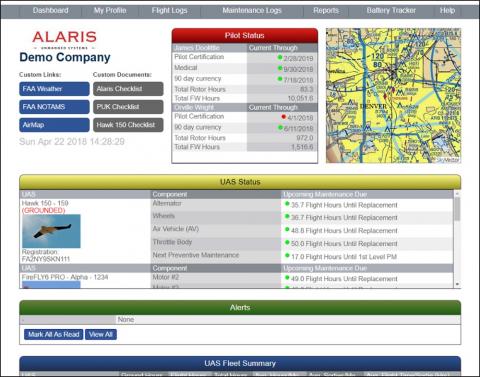
This led Pucciarella to start designing the architecture for AlarisPro, UAS fleet management software that helps keep track of vital information regarding drones.
Among many things, the software provides detailed reports, flight and maintenance logs, and a dashboard that includes pilot status, UAS status and alerts, with colors — green (good), yellow (caution) and red (item is past due) — to indicate the current standing.
Altavian to support largest small UAS program in the world thanks to new contract with US Army
Altavian, Inc. has been awarded a $250 million Indefinite Delivery, Indefinite Quantity contract with the US Army.
Altavian will support the largest small UAS program in the world, under the Program Executive Office Aviation, Products Office for Tactical Unmanned Aircraft (TUAS).
The US Army Family of Systems, Unmanned Aircraft Systems (FoSUAS) includes the RQ-11 and RQ-20 UAS, as well as supporting control and communications equipment, and other technologies to be fielded over the contract period of performance.
All systems are designed to be carried by a “single dismounted warfighter,” quickly assembled, and deployed to provide “immediate over-the-hill surveillance and reconnaissance.”

Persistent Systems' technology provides value for the UGV market
Founded just over a decade ago in 2007 by Herbert B. Rubens, CEO, and David Holmer, CTO, Persistent Systems is a leader in mobile ad hoc network (MANET) technology, and the company claims to have the most advanced, scalable and efficient MANET radio in the world, in its MPU5 (Man Portable Unit 5) radio system.
MANET effectively allows users to bring their access points with them, which allows every node — whether UGV, UAV, or something else — to be totally independent, and have the ability to relay for other nodes automatically. This provides a major benefit to users in the field, according to Louis Sutherland, vice president of business development at Persistent Systems.
AEE and SELFLY Camera develop UAS-smartphone-case called AEE SELFLY
AEE Aviation Technology Inc. and SELFLY Camera LLC have introduced AEE SELFLY, which is a smartphone case with an embedded UAS.
Considered the first device of its kind and the first of its class, AEE SELFLY gives smartphone users the ability to capture photos of themselves—commonly known as “selfies”—at a whole new level of quality and precision, for basically any event, from any location, and from heights and distances that were once considered impossible.
“More photographs are being taken now on smartphones than ever before because the best camera is the one you can always have with you,” says Mike Kahn, AEE's Chief Marketing Officer.
NVIDIA and Aurora to develop new Level 4 and Level 5 self-driving hardware platform
NVIDIA and self-driving tech company Aurora have announced that they are collaborating to develop a new Level 4 and Level 5 self-driving hardware platform that will utilize the NVIDIA DRIVE Xavier processor.
During the opening press conference of CES 2018 in Las Vegas, NVIDIA founder and CEO Jensen Huang revealed that the company’s automotive team is working with Aurora to “bring up a new modular and scalable DRIVE Xavier platform that will bring autonomous vehicles to market.”
From Unmanned Systems magazine: Market Report Part 2: Legacy geographies point to new growth in radio frequency UAS sensors
Airborne synthetic aperture radars, or SARs, process radar returns as if they were collected by an antenna as much as several hundred meters long.
This “synthetic” antenna aperture is created by the movement of the aircraft itself — which is why airships do not make good SAR platforms — and allows a “parallax view” of the ground similar to a stereoscopic optical image. SARs were developed during the Cold War for their radio frequency ability to provide ground reconnaissance through the clouds and bad weather in Europe, unlike visual, infrared, and even hyperspectral sensors, and for ground moving target indication, which measures the displacement of vehicles and other objects during the radar scan.

Persistent Systems to provide its MPU5 radio to Endeavor Robotics for US Army UGVs
Persistent Systems, LLC, which is a leader in Mobile Ad hoc Network (MANET) technology, has announced that it is a part of Endeavor Robotics’ winning team for the US Army’s MTRS Inc II Award (Man-Transportable Robotic System Increment II), which is a $100 million contract award.
The award has an option for an additional “$58 million worth of deliverables” to provide a fleet of up to 1,200 mid-sized UGVs to the US Army.
As Endeavor’s MANET radio of choice, Persistent Systems’ MPU5 radio will provide “secure and long-range data communication” for C2 (command and control), video, CBRNe, and other vital sensor data.