Date/Time: Wednesday, November 17 at 3:00 - 4:00 pm ET
Components
Components
The Use of AI in Industrial Application Inspection
From small drones for retail sales to larger maritime vessels for public safety uses, specification requirements for manufacturers of unmanned systems vary as widely by the types of systems being made, materials and methods employed, and the sites of production.
TeledyneDALSA, part of the Teledyne Imaging Group, is a leading provider of technologies for industrial growth markets, and understands the challenges US manufacturers face and offers solutions enabled by artificial intelligence (AI) and machine learning (ML) to meet these needs throughout the full manufacturing workflow.

Wibotic launches software to simplify complexity that comes with keeping large fleets charged
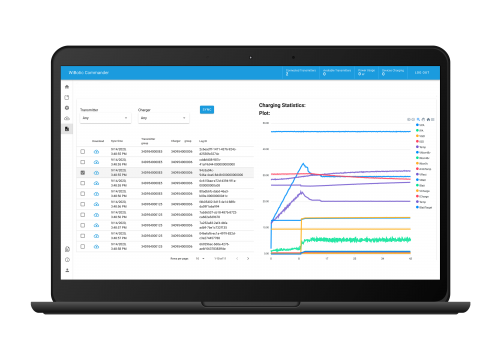
Seattle-based Wibotic last week launched a software package to help customers manage the increasingly complex array of tasks necessary to keep vehicles in growing unmanned fleets charged and ready to perform.
The software, called Commander, offers constant, at-a-glance awareness of all vehicles through a user-friendly interface, said CEO and co-founder Ben Waters. Users will be able to assess quickly how soon vehicles need to be charged, as well as to gather data on things like power usage and battery performance over time – to inform future scheduling and purchasing decisions.
“It might be used for a single vehicle on a single site, or a single vehicle on hundreds of sites, or it could be used for hundreds of vehicles on one site,” Waters said.
Printing the future: Cobra Aero rethinks designing for additive manufacturing with nTopology
By Lynn Manning
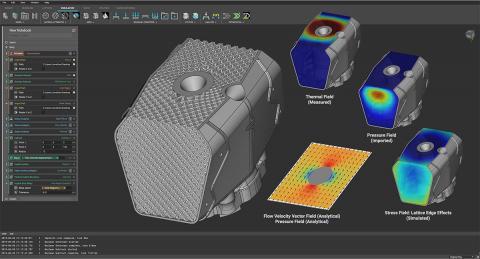
When a fast-growing company designs and manufactures some 2,000 small engines per year, it likes to stay abreast of the latest digital-engineering tools. Yet Sean Hilbert, president of Cobra Aero, is also adamant that the final proof of the integrity of every power and propulsion product he creates for his drone and motorcycle customers is always the test bench.
“In my experience with moving back and forth between the computer-aided engineering and the testing realms, honing in on that final design always requires a real-world check,” Hilbert says. “You need those digital-to-physical iterative loops in order to calibrate your models and make a great design.”
Hirth Engines showcasing lightweight propulsion system technologies for UAS during Xponential
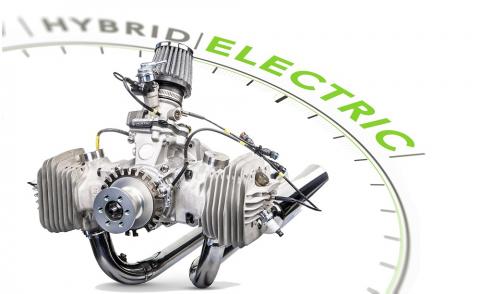
Hirth Engines has announced that during Xponential 2019, it will demonstrate its future innovation program, and showcase the latest lightweight propulsion system technologies.
With its two-stroke propulsion systems, Hirth says that it meets customers’ needs for endurance, reduced footprints, lightweight platforms, cost-effectiveness and safer operations.
To deliver technologies for the future, Hirth says that it is now looking toward hybrid applications to “harness the power” of both an internal combustion engine and electrical motors.
Triumph Group selected to provide hydraulic system components for MQ-25 unmanned aerial refueling program
Boeing has awarded Triumph Group a contract to supply critical hydraulic system components for the MQ-25 unmanned aerial refueling program.
Headquartered in Berwyn, Pennsylvania, Triumph Group designs, engineers, manufactures, repairs and overhauls a diverse portfolio of aerospace and defense systems, components and structures.
The components for the hydraulic systems used in the landing gear and the aircraft's arresting systems will be provided by Triumph Integrated Systems, which also provides similar content on other Boeing defense aircraft.

Teledyne Gavia to formally introduce SeaRaptor AUV in April
Teledyne Gavia has announced that it will formally introduce its new 6000-meter rated AUV, SeaRaptor, in April.
SeaRaptor incorporates a variety of Teledyne components, including ascent and descent weight releases, multi-beam echosounders, obstacle avoidance multi-beam sonar (Teledyne RESON, Denmark) and Current, Temperature, and Depth sensor (CTD) (Teledyne RD Instruments, San Diego, CA).
Teledyne Gavia notes that the first vehicle delivered also carried an Edgetech Side Scan Sonar with Dynamic Focus capability, an iXblue Phins 6K INS system, and a CathX Camera and strobe system.

Silvus Technologies supplying wireless datalink used on Aerovel Flexrotor UAS in pursuit of US Army FTUAS program
In pursuit of the US ARMY Family of Tactical UAS (FTUAS) program, Silvus Technologies Inc. has announced that it is supplying the wireless datalink used on the Aerovel Flexrotor, which is a 50-pound UAS designed for maritime and land-based operations.
A 2x2 MIMO Software Defined Radio (SDR), Silvus Technologies' StreamCaster 4200 (SC4200) features the company's proprietary MN-MIMO waveform, which supports high bandwidth Mobile Ad Hoc Networking (MANET) in a variety of environments.
Other unique features include Transmit Eigen Beamforming (a MIMO technique which boosts signal strength two to four times), dual-band interference mitigation capabilities, and a miniature form factor just 0.75” thick and the footprint of a typical business card.
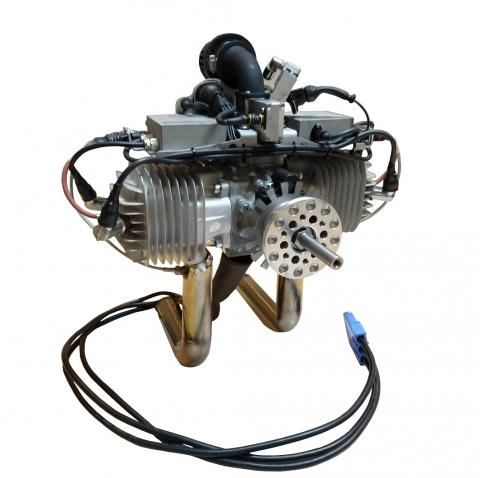
Sky Power GmbH unveils newly developed 2-stroke engine
Sky Power GmbH, which manufactures 2-stroke combustion- and Wankel engines for UAS and hybrid applications, has unveiled its newly developed 2-stroke engine, the SP-210 FI TS.
Based on the same engine concept as the company’s SP-110 FI TS, the SP-210 FI TS has a “max. 8,2 kW at 5000 rpm,” Sky Power says.
The SP-210 FI TS has a system carrier just like the SP-110 FI TS—although it is optionally offered without a system carrier as well—which is mounted above the cylinders with the two electronic systems of the HKZ215 ignition, as well as the engine injection system.
The injection system and the system carrier are screwed firmly together with the engine.
Ouster says its newest lidar sensor is the highest resolution lidar on the market
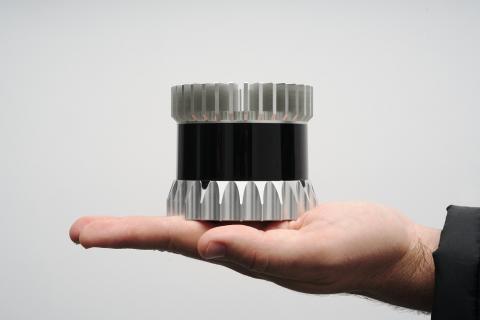
On Jan. 3, Ouster announced the OS-1-128, the company’s newest multi-beam flash lidar sensor.
Ideal for “safety-critical robotics applications” such as autonomous vehicles, the OS-1-128 is the highest resolution lidar on the market, Ouster says.
With no change in size, mass, power consumption, or ruggedness compared to the OS-1-64, the OS-1-128 continues to deliver on the promise of “Moore's Law-esque” product improvements enabled from Ouster's Multi-Beam Flash Lidar architecture, the company explains.
Priced at $18,000, the OS-1-128 is six times cheaper than the competing 128-channel lidar sensor, according to Ouster, allowing the company to extend its commitment of providing the lowest pricing at every performance level.