
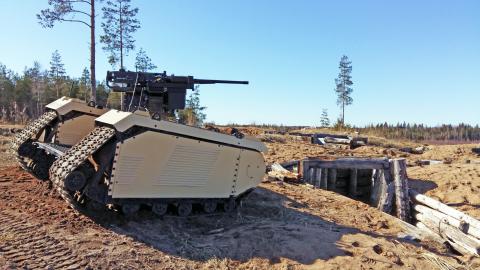
During a live fire exercise in April held in Tapa, Estonia, Milrem Robotics and ST Engineering demonstrated a beyond visual line of sight (BVLOS) combat UGV armed with a 40-millimeter AGL and a 12.7-millimeter HMG.
Made up of Milrem Robotics' THeMIS UGV and ST Engineering's ADDER DM Remote Weapon Station, the joint warfare system is meant to be a force multiplier for dismounted troops that can be used in urban areas, as well as rural areas.
BVLOS
BVLOS
Iris Automation launches detect and avoid tech to enable BVLOS operations for UAS
Iris Automation has launched Casia, which the company describes as the “first commercially available computer vision detect-and-avoid solution to enable beyond visual line of sight (BVLOS) operations for autonomous vehicles.”
According to Iris, Casia allows a UAS to truly understand the aviation environment around it as if a pilot were on board, as it detects other aircraft, classifies them using machine learning, and makes intelligent decisions about the threat they may pose to the vehicle, and triggers automated maneuvers to avoid collisions.
Grand Sky, Harris create BVLOS 'super corridor'
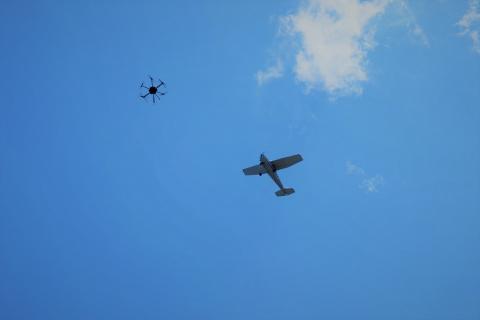
Grand Sky Business and Aviation Park and Harris Corp. have announced that they have collaborated to enable the country’s first and largest UAS airspace to support beyond visual line of sight (BVLOS) flight operations, as well as UAS Traffic Management (UTM) research.
Described as a “super corridor,” the BVLOS corridor, which stretches up to 100 miles, is the “most technologically sophisticated UAS airspace supported by multiple and redundant systems for cooperative and non-cooperative surveillance,” according to Grand Sky and Harris.
A variety of UAS BVLOS applications are possible thanks to these surveillance capabilities, including in oil and gas, public safety and package deliveries.
senseFly drones approved for Brazil's first-ever BVLOS operations
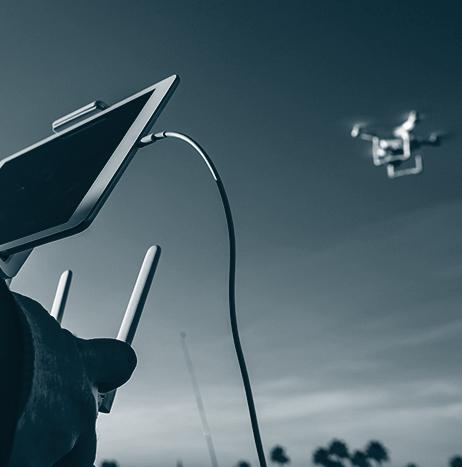
In collaboration with drone engineering and consulting specialists AL Drones and geotechnology company Santiago & Cintra, senseFly has announced that the National Civil Aviation Agency (ANAC) has approved beyond visual line of sight (BVLOS) flights to be carried out in Brazil for the first time in the country’s history, using UAS technology from senseFly.
SenseFly’s UAS can now be used for future BVLOS missions conducted by Brazilian drone operators.
“This is a momentous step forward for BVLOS operations in Brazil, and a really exciting time for the country’s expanding commercial drone industry,” says Pierre-Alain Marchand, regulatory compliance manager, senseFly.

Flirtey granted permission to conduct BVLOS UAS delivery flights under UAS IPP
The city of Reno, Nevada has announced that Flirtey—one of its partners in the UAS Integration Pilot Program (IPP)—has received approval from the FAA to conduct beyond visual line of sight (BVLOS) UAS delivery flights.
With the approval, Flirtey will be able to conduct UAS delivery operations with a pilot controlling the flights from a remote location.
“Flirtey’s industry-leading technology is now approved for drone delivery beyond visual line of sight, a major milestone that brings life-saving and commercial drone delivery another step closer to your doorstep,” says Flirtey Founder and CEO Matthew Sweeny.

Schiebel demonstrates Camcopter S-100 UAS during trials in Nigeria
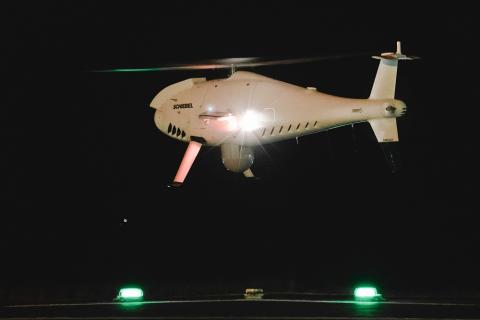
Schiebel has announced that during trials in Rivers State, Nigeria from January 27 to 30, its Camcopter S-100 UAS demonstrated its capabilities to a large European oil and gas corporation.
According to Schiebel, the international oil and gas industry has shown increasing interest in using UAS to effectively monitor and control oil and gas infrastructure, both onshore and offshore.
With this in mind, the flight trials in Nigeria were designed to further investigate the implementation and potential advantages of UAS technology, as Schiebel says that its vertical takeoff and landing (VTOL) Camcopter S-100 UAS offers a “substantial enhancement” for Intelligence, Surveillance and Reconnaissance (ISR) missions in an oil and gas production environment.
In-Flight Data awarded three Guinness World Records for recent BVLOS UAS flights
In-Flight Data has been awarded three Guinness World Records for UAS flights it recently conducted as part of a beyond visual line of sight (BVLOS) project in collaboration with senseFly.
Through the project, In-Flight Data conducted the longest cumulative BVLOS battery-powered UAS flight, covering 2,723.04 kilometers; the longest cumulative urban flight for a BVLOS civilian UAS (small class – up to 25 kilograms), covering 414 kilometers; and the longest single urban flight for a BVLOS civilian UAS (small class – up to 25 kilograms), covering 40 kilometers.
Cranfield University and Blue Bear conduct first UAS test flights to establish principles for NBEC project
Cranfield, England's Cranfield University has announced that the first test flights to establish the principles for the National Beyond visual line of sight Experimentation Corridor (NBEC) were successfully conducted at Cranfield Airport.
A collaboration between Cranfield University and Blue Bear Systems Research Ltd, NBEC seeks to create an experimentation corridor that will enable UAS to fly in the same airspace as manned aircraft.
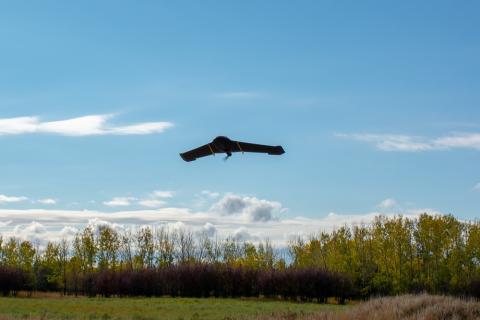
Using its Blackstart UAS towards its facility in Oakley, Bedfordshire, Blue Bear executed three-kilometer Extended Visual Line of Sight (EVLOS) race track flights within the Cranfield Air Traffic Zone.
NUAIR Alliance and others test impact of wind on air worthiness and performance of UAS
The New York State UAS Test Site, TruWeather Solutions, the NUAIR Alliance and a company called Windshape have announced that using “industry-leading” micro-weather stimulations, they tested the impact of wind on the air worthiness and performance of various types of UAS.
Testing took place at the New York State UAS Test Site at Rome, New York's Griffiss International Airport.
“We know that weather impacts small drones in a variety of ways and these tests enabled us to evaluate that impact and each platform’s capacity to reject atmospheric disturbances and maintain safe flight,” explains Major General Marke F. “Hoot” Gibson (ret), chief executive officer, NUAIR Alliance.
Airobotics receives waiver to operate UAS BVLOS from Remote Operations Center in Australia
Airobotics has announced that it recently obtained the first and only Civil Aviation Safety Authority (CASA) approval in Australia to operate automated UAS from its Remote Operations Center (ROC) beyond visual line of sight (BVLOS) with no aircrew needed at the client site.
Remote pilots are located at a designated Remote Pilot Station (RPS) within Airobotics Australia’s ROC. They are operating more than 1,000 kilometers away from onsite systems at the customer sites.
According to Airobotics, this new “man on the loop” level of operations allows human operators to supervise flights without the need for “man in the loop” pilots to intervene in flight operations.