
A transport operator called FirstGroup will conduct research on shared autonomous vehicles at the Concord, California-based GoMentum Station, after signing an agreement with the federally designated automated vehicle proving ground.
Through the partnership, First Transit, which is a United States division of the United Kingdom-headquartered FirstGroup, will use the 2,000-hectare test facility as a test site for “innovative transport applications.”
One of the applications that First Transit will use the test facility for is a pilot project that began back in 2016, which seeks to deploy the “first commercially operated shared autonomous vehicle on public roads in the United States.”
Business Solutions
Business Solutions
New York’s Orange County set to begin using UAS
Orange County, New York’s Emergency Services Department will begin using UAS for a variety of tasks around the county.
The UAS program will be overseen by Deputy Commissioner of Emergency Services Alan Mack.
Mack, who is a licensed UAS operator and recent retiree from the U.S. Army, is looking forward to getting this new technology into the sky.
“The drones will be a valuable tool in many emergency situations and we are eager to put this program into practice,” Mack says via the Hudson Valley News Network.

RE2 Robotics chosen to develop technology that will convert manned aircraft to robotically piloted, autonomous aircraft
The United States Air Force has selected Pittsburg-based RE2 Robotics to develop the Common Aircraft Retrofit for Novel Autonomous Control (CARNAC) robotic system, which will serve as “a drop-in robotic system to rapidly convert a variety of traditionally manned aircraft to robotically piloted, autonomous aircraft under the Small Business Innovation Research (SBIR) program.”
The CARNAC robotic system, which will utilize existing aviation assets and advances in vehicle automation technologies during its development, will be used to operate the aircraft in a similar fashion to how a human pilot does, and there will not be any modifications required to the aircraft.
Kansas State University Polytechnic Campus receives approval to fly UAS at night
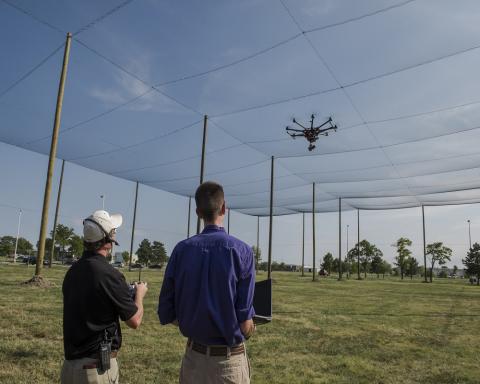
The FAA has granted Kansas State Polytechnic's Applied Aviation Research Center permission to fly UAS at night.
The campus's research sector will benefit from this waiver, and the waiver will also be used in commercial flight training courses, as well as in upcoming curriculum in the UAS degree option.
Intel partners with International Olympic Committee to bring its Drone Light Show to future Olympics
Intel has announced a long-term technology partnership with the International Olympic Committee (IOC), which will, among many things, bring Intel’s drone light show technology to future Olympic games, in an effort to create “never-seen-before images in the sky.”
Through the partnership, which is expected to “transform the Olympic Games and the Olympic experience," Intel will join “The Olympic Partner” (TOP) worldwide sponsorship program, and thus, become a Worldwide TOP Partner through 2024.

3D Robotics to offer Site Scan to AEC professionals in Japan after partnering with SoftBank C&S
3D Robotics (3DR) has announced a new partnership with one of Japan’s largest distributors of information and communications technology, SoftBank C&S, which will result in 3DR providing its Site Scan UAS data platform to AEC professionals in Japan.
Site Scan will be the only commercial UAS software offered by SoftBank, which will open up the power of UAS data to Softbank’s customers across Japan.
“Aerial data software like Site Scan is already driving productivity for our customers in Japan,” says Matt Harrison, Head of Sales at 3DR.
“The partnership with SoftBank will allow 3DR to meet the demand for drone data across the country.”
Kongsberg Maritime’s HUGIN AUV chosen by University of Gothenburg for marine research
Kongsberg Maritime’s HUGIN AUV has been selected by the University of Gothenburg, and the AUV will be used to expand the capabilities of Sweden in the field of marine research, using unmanned vehicles and platforms.
The AUV, which is expected to be delivered in February 2018, will be recognized “as a national asset for marine research projects around Sweden and further afield.”
“In order to map the ocean environment to the degree that vital climate change research requires, we need to focus more on increasing our use of autonomous observation platforms,” says Anna Wåhlin, Professor in Oceanography, University of Gothenburg, through an article from Marine Technology News.
Rockwell Collins avionics chosen by General Atomics Aeronautical Systems to support UAS ground control station
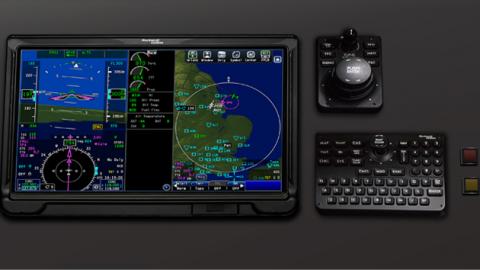
General Atomics Aeronautical Systems Inc. (GA-ASI) has selected the Rockwell Collins Pro Line Fusion integrated avionics system to support the company’s MQ-9B SkyGuardian UAS.
In an effort to simply civil airspace access, Rockwell Collins will offer support to GA-ASI to “efficiently upgrade the proven Predator B Remotely Piloted Aircraft (RPA) system.”
The UAS ground control station will utilize the capabilities of the Rockwell Collins Pro Line Fusion integrated avionics system, to support customers and missions that require operations in civil airspace.
Kespry enters insurance sector and brings UAS platform with it
Kespry has formally entered into the insurance sector, which will allow the company to “extend its end-to-end and easy-to-use enterprise drone platform by offering insurance specific functionality such as inspection-quality imagery for roofing and automated analysis to assist claim adjusters.”
The Kespry UAS captures data that delivers high-resolution imagery with 1 mm per pixel resolution, which can detect physical damage and granule loss. Rooftop imagery is available onsite in less than 10 minutes, giving field and desk adjusters access to comprehensive roof dimensions and automated damage detection.