
SeeByte has renewed all SeeTrack and Neptune licenses currently operated by the Royal Navy’s Maritime Autonomous Systems Trials Team (MASTT).
Working in collaboration with ATLAS ELEKTRONIK UK, SeeByte, which is part of the Defence Equipment and Support (DE&S) Mine Countermeasures and Hydrographic Capability program, will be offering full support and maintenance for MASTT.
The software is integrated into MASTT’s AUV fleet to coordinate the vehicles during Mine Countermeasure (MCM) missions.
Defense
Defense

GA-ASI to provide UAS to Royal Netherlands Air Force
After consideration by the Ministry of Defence for the Netherlands, General Atomics Aeronautical Systems Inc. (GA-ASI) has been selected to provide the Royal Netherlands Air Force (RNLAF) with its UAS.
GA-ASI will deliver its Predator B/MQ-9 Reaper Medium Altitude, Long-endurance (MALE) UAS to the Dutch Military.
“We are extremely pleased to have the opportunity to meet the UAS requirements of the Royal Netherlands Air Force,” says Linden Blue, CEO of GA-ASI.
“We are committed to providing a NATO-interoperable solution that enhances the ISR capabilities of the Netherlands and the Alliance.”

AeroVironment selected for small UAS sustainment under five-year IDIQ contract
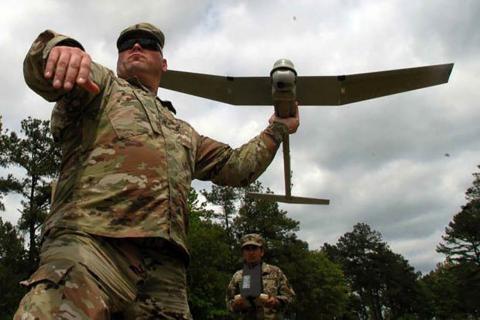
AeroVironment Inc. has announced that on April 10, the United States Army selected it, along with six other suppliers, for small UAS sustainment under a five-year Indefinite Delivery Indefinite Quantity (IDIQ) contract.
Over the duration of the contract, the seven awardees will compete for LRRS and MRM UAS, Tactical Open Architecture Controller system and spare and repair parts procurement task orders.
The maximum value of the contract is $248 million over five years.
From Unmanned Systems magazine: Military objectives could advance driving systems to full autonomy
Semi-autonomous vehicles traveling in convoys, or platoons, have the potential to save lives and transport material more efficiently and safely than manned vehicles, but the technology has a way to go before it can be touted as fully autonomous.
In the commercial sector, the rush to full autonomy is limited by fuel cost efficiencies already achievable with semi-autonomous systems, but the need to protect soldiers on the ground and in war zones may drive the U.S. military to advance the technology into full automation sooner rather than later.

Integrated fuel tank maximizes fuel load for MQ-25
In an effort to maximize fuel offload for the proposed MQ-25 unmanned aerial refueling aircraft for the U.S. Navy, General Atomics Aeronautical Systems Inc. (GA-ASI) has announced that it is using an integrated fuel tank structure.
Using its knowledge of advanced composite aircraft structures, GA-ASI developed integrated fuel tanks in a “large-scale wing box test article and a full-scale wing skin pre-production validation article.”
Last November, the wing box tested to failure via wing bending at GA-ASI’s structural test facility in Adelanto, California. In April, GA-ASI verified the production readiness of the co-cured wing and tail components, using both non-destructive and destructive inspections.

Weekend Roundup
This week in the unmanned systems and robotics world
The Colorado Division of Fire Prevention and Control has deployed unmanned aircraft to survey growing damage caused by several wildfires in the state. An official said the information gathered by one of the drones is crucial to providing the department an estimate of the size of one of the fires. (The Independent)
Vanilla Aircraft is now Vanilla Unmanned, a joint venture
Platform Aerospace, which provides rapid aircraft and drone prototyping, modification, and systems integration, has established a joint venture with an unnamed partner to acquire substantially all the assets of Vanilla Aircraft, which designed and built the VA001 ultra-endurance UAS.
The joint venture, named Vanilla Unmanned, will leverage Platform Aerospace’s prototyping and integration experience and the partner’s experience with aerospace and defense electronics to further develop the record-setting VA001, “creating a disruptive persistent aerial solution for both military and commercial applications,” the new company says.
Insitu's ScanEagle to provide small UAS ISR services aboard entire U.S. Coast Guard National Security Cutter fleet
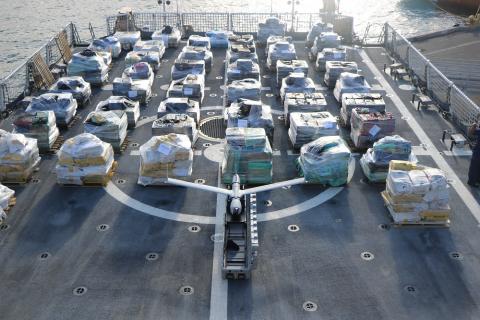
After being awarded a United States Coast Guard (USCG) contract award, Insitu’s ScanEagle UAS will be used to provide small UAS ISR services aboard the entire U.S. Coast Guard National Security Cutter fleet.
Valued at approximately $117 million, the service contract covers the installation and deployment of small UAS for 200 hours per 30-day operational patrol period. ScanEagle will be used for a variety of tasks, including conducting surveillance, detection, classification and identification operations.
The UAS will also be used to “support prosecution” by providing real-time imagery, data, target illumination, communications relay and other capabilities to the fleet, as well as other government platforms as needed.
FLIR Systems announces Black Hornet 3 nano UAS
FLIR Systems Inc. has announced the launch of its latest UAS, the Black Hornet 3 nano UAS, which is designed for use by global militaries, government agencies, and first responders.
FLIR’s Black Hornet Personal Reconnaissance System (PRS) is already the “world’s smallest combat-proven” nano-UAS. The next generation Black Hornet 3 nano UAS adds the ability to navigate in GPS-denied environments, giving the warfighter the ability to maintain situational awareness, threat detection, and surveillance no matter the location of the mission.
AeroVironment receives contract awards from U.S. Army for its Switchblade Lethal Miniature Aerial Missile System and Contractor Logistics Support
AeroVironment has announced that in April, it received contract awards from the United States Army for procurement of its Switchblade Lethal Miniature Aerial Missile System (LMAMS) and Contractor Logistics Support (CLS), bringing the total value of Switchblade awards to $111,054,202 since August 2017.
With the AeroVironment Switchblade, warfighters are provided with “rapid-response force protection and precision strike capabilities” up to 10 kilometers from its launch location. The Switchblade has been deployed by U.S. forces for more than five years.