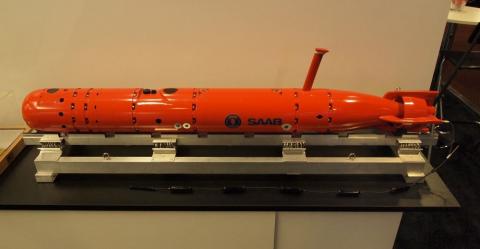
Just over a year after the ARA San Juan went missing, Ocean Infinity found the Argentine Navy submarine on Nov. 17 using its AUVs.
According to Ocean Infinity, the submarine was found in a ravine in 920 meters of water, approximately 600 kilometers east of Comodoro Rivadavia in the Atlantic Ocean.
“Our thoughts are with the many families affected by this terrible tragedy. We sincerely hope that locating the resting place of the ARA San Juan will be of some comfort to them at what must be a profoundly difficult time,” Ocean Infinity’s CEO Oliver Plunkett said after the ARA San Juan was found.
AUV
AUV
Ocean Infinity orders five Kongsberg Maritime HUGIN AUVs
Ocean Infinity has placed three separate orders for a total of five Kongsberg Maritime HUGIN AUVs, which will increase the company’s inventory to 15.
According to Kongsberg, the AUVs are equipped with the latest generation Kongsberg Maritime HISAS 1032 synthetic aperture sonar, which gives Ocean Infinity a total of six HUGIN AUVs in its fleet that have the ability to deliver high resolution imaging.
“We are pleased to continue to support Ocean Infinity’s operations and value the confidence placed in the HUGIN AUV,” comments Thomas Nygaard, vice president Marine Robotics, Kongsberg Maritime.

MBARI engineers demonstrate using long-range AUV for detecting and tracking oil spills
Late last month, Monterey Bay Aquarium Research Institute (MBARI) engineers demonstrated using MBARI’s long-range AUV (LRAUV) for detecting and tracking oil spills.
The engineers, who worked with the US Coast Guard and collaborators at Woods Hole Oceanographic Institution (WHOI), equipped an LRAUV with special instruments (fluorometers) that can detect oil in water. During the recent test in Monterey Bay, the MBARI team simulated an oil spill using non-toxic, biodegradable dye.
According to MBARI, the Coast Guard is very interested in testing robots that can find and track oil spills under ice; a capability that will be crucial as ship traffic and oil exploration expands in the Arctic Ocean, MBARI says.
Royal Netherlands Navy equips its New Generation Remus 100 AUV Fleet with SeeByte's Neptune software
The Royal Netherlands Navy (RNLN) has successfully integrated SeeByte’s Neptune software into its New Generation Remus 100 AUV Fleet.
Neptune is SeeByte’s goal based mission planning and autonomy engine software. The software allows for the expedition and optimization of single and multi-vehicle operations.
“We are privileged to be in a position to continue working with The Royal Netherlands Navy and assist in their goal to achieve security at and from the sea,” says SeeByte’s Technical Client Manager, Alastair Cormack.
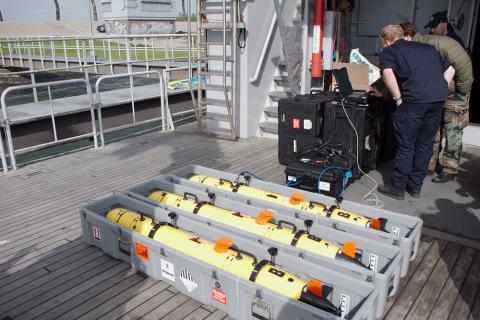
SeeByte renews SeeTrack and Neptune licenses currently operated by Royal Navy's MASTT AUV fleet
SeeByte has renewed all SeeTrack and Neptune licenses currently operated by the Royal Navy’s Maritime Autonomous Systems Trials Team (MASTT).
Working in collaboration with ATLAS ELEKTRONIK UK, SeeByte, which is part of the Defence Equipment and Support (DE&S) Mine Countermeasures and Hydrographic Capability program, will be offering full support and maintenance for MASTT.
The software is integrated into MASTT’s AUV fleet to coordinate the vehicles during Mine Countermeasure (MCM) missions.
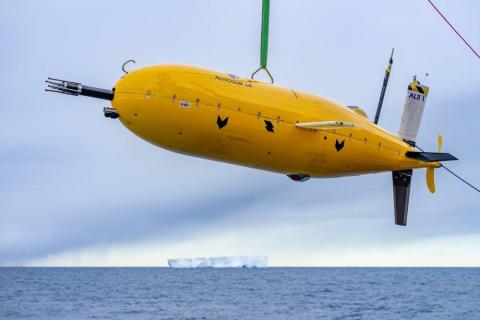
Boaty McBoatface AUV successfully completes first under-ice Antarctic mission
Last week, the National Oceanography Centre’s (NOC) Autosub Long Range (ALR) AUV —popularly known around the world as ‘Boaty McBoatface’—was successfully recovered following its first under-ice mission beneath the Filchner Ice Shelf in West Antarctica.
The AUV was deployed in the southern Weddell Sea from January to February 2018 during RV Polarstern cruise PS111, as part of the Filchner Ice Shelf System (FISS) Project, which is a collaboration that involves several leading UK research institutions, including the NOC.
The AUV plays an important role in the project that aims to investigate and describe the “current state of the complex atmosphere-ice-ocean system.”
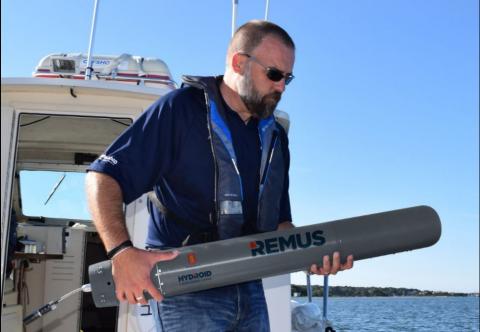
Hydroid releases compact, one-man portable REMUS M3V AUV
Hydroid Inc. has announced the release of the REMUS M3V, a compact, one-man portable AUV that is low cost and ready to use right out of the box.
Capable of diving up to 300 meters in depth, the REMUS M3V can be used to support a variety of applications, including search and survey; intelligence, surveillance and reconnaissance (ISR); marine research; and multi-vehicle missions.
Considered a “true A-size (36" x 4.875") vehicle,” the micro AUV has no fins or appendages outside the A-size envelope, and can be used for multi-domain deployments.
Weekend Roundup
This Week in the Unmanned Systems and Robotics World
Elistair has announced the launch of its ORION UAS, which is the “next generation of persistent tethered drone systems,” according to the company. Elistair says that the UAS is designed for semi-persistent aerial surveillance and telecommunications needs, allowing it to handle the most difficult missions across a variety of sectors, including law enforcement, private and public safety, and national security, just to name a few. (Elistair)

ECA Group unveils AUV A18-M for underwater mine warfare
France’s ECA Group has unveiled its new generation mid-size AUV A18-M for underwater mine warfare.
Built for “efficient mine detection and classification in all water depths up to 300m,” AUV A18-M is specifically designed to operate in the close vicinity of the smartest mines without triggering them, according to ECA Group.
Regarding AUV A18-M, ECA Group says that “with its compactness and its unequaled high-quality imagery this new generation underwater drone becomes the reference in the category of autonomous underwater vehicles dedicated to mine hunting.”
Saab to demonstrate acoustic target for U.S. Navy
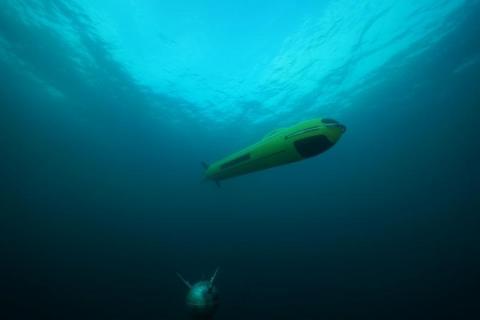
Saab has announced that it will demonstrate its anti-submarine warfare (ASW) training system, the AUV62-AT (acoustic target), for the U.S. Navy this summer.
The AUV62-AT, an artificial acoustic system that mimics a submarine, will be evaluated by the Navy against Naval systems through the Foreign Comparative Testing (FCT) Program. The AUV62-AT will be operated by Navy personnel, with Saab engineers there to support it if there is any maintenance required.
“With submarine usage on the rise, anti-submarine warfare training is more crucial than ever,” says Görgen Johansson, senior vice president and head of Saab´s Business Area Dynamics.