
Many people think of artificial intelligence as something all-consuming, a superior computer thinking ability that could make humans obsolete.
Decades of books, movies and TV shows have warned seems like an inevitable computer or robotic uprising, including the 1920 stage play, “Rossum’s Robots,” which gave us the term robot in the first place.
And tech industry leaders such as Mark Zuckerberg on Musk have been arguing lately about AI and whether it’s a force for good, as Zuckerberg posits, or an existential threat to humanity, as Musk says.
Artificial Intelligence
Artificial Intelligence
Lyft and Drive.ai partner to work on self-driving cars
In an effort to bring self-driving cars to the Bay Area on its open platform, Lyft has announced a partnership with Drive.ai, which is a Silicon Valley startup that uses deep learning to create artificial intelligence (AI) software for autonomous vehicles.
UAS equipped with shark detection system to patrol Australian beaches starting in September
In an effort to improve safety in regards to shark attacks, UAS equipped with a shark detection system that is powered by artificial intelligence will be used to patrol some beaches in Australia starting in September.
After being provided a live-video feed via the battery-powered UAS, the UAS operator will use “shark-spotting software” to identify sharks in real time, with more accuracy than the human eye.
Studies have shown that when interpreting data from aerial images to detect shark activity, people have an accuracy rate between 20 and 30 percent.
According to Dr Nabin Sharma, a research associate at the University of Technology Sydney’s School of Software, that rate can be raised to 90 percent when using detection software.

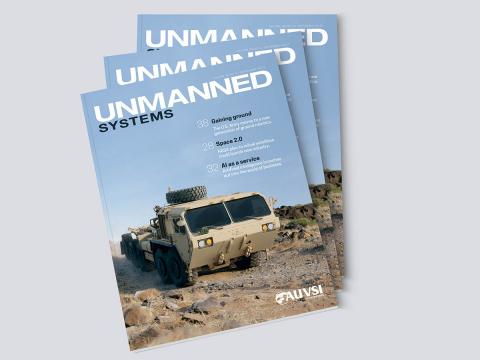
Inside the September 2017 issue of Unmanned Systems
The September 2017 issue of Unmanned Systems looks at Army plans for robotics, NASA plans to use robotics to refuel satellites in space, and how businesses, artists and others are using artificial intelligence to improve their products and services.
Nevada UAS Test Site and Microsoft test artificial intelligence in Microsoft’s UAS
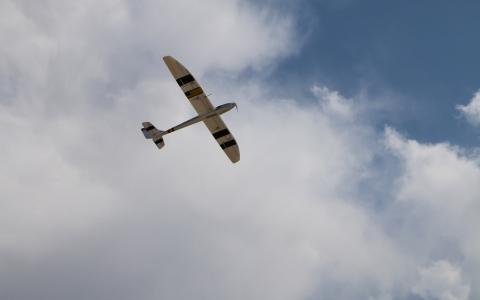
The Nevada Governor’s Office of Economic Development (GOED) and the Nevada Institute for Autonomous Systems (NIAS) have teamed up with Microsoft's UAS research team to test Artificial Intelligence (AI) in Microsoft’s sailplane.
The sailplane being tested, which is 16.5 feet and weighs 12.5 pounds, relies on a battery to “run onboard computational equipment and controls,” including the rudder, and radios to communicate with the ground.
The UAS also has a motor, which allows a pilot to take over manual operation if and when necessary.
During this set of tests though, the UAS demonstrated its ability to operate on its own, as it found and used thermals to travel without the help of the motor or a person.
Oregon State University researchers receive grant to study operation of autonomous marine vehicles
Five Oregon State University (OSU) researchers have received a $1 million grant from the National Science Foundation (NSF). The grant will be used to study the operation of autonomous marine vehicles.
Building on cross-campus collaborations, the project brings together engineers and ocean scientists so that they can produce “innovations in OSU-developed ocean-sensing technologies,” such as the robotic oceanographer surface sampler (ROSS), and advanced underwater glider operations.
Ultimately, the project will look improve the autonomous capabilities of vehicles by increasing their “neglect tolerance,” which is the ability to function for long periods of time despite minimal or no communication with a human technician.
Defense. Protection. Security: Opportunities with AUVSI
Join AUVSI as we host unmanned systems thought leaders for a discussion of their visions for the community and outline how the technology will be integrated into the operations of an increasing number of government agencies. As the capabilities and application of unmanned technology changes, AUVSI’s programming changes with it, which is why we’re pleased to announce the new AUVSI Unmanned Systems—Defense. Protection. Security. (USDPS)! This webinar is your opportunity to preview the types of speakers and innovative ideas you can expect to hear at the event to be held February 6-8, 2018 at the Gaylord National Resort & Convention Center in National Harbor.
Self-driving cars to be tested on interstates in Northern Virginia
According to WTVR.com, self-driving and wireless connected cars are headed to the roads in Virginia, after the Commonwealth Transportation Board approved the testing of these vehicles in High Occupancy Toll (HOT) lanes on Interstate 95 and Interstate 495 in Northern Virginia.
Initially, the cars will be tested on closed roads, but eventually, they will be tested during “light traffic” times.
According to Virginia Department of Transportation Research Director Cathy McGhee, fellow occupants on the road should not notice anything unusual once these self-driving vehicles begin testing.

Autonomous vehicle technology company Nauto raises $159 million
An autonomous vehicle technology company called Nauto has closed a $159 million Series B financing round, which was led by a subsidiary of SoftBank Group Corp. and Greylock Partners.
According to Nauto, the funds will be used to “fuel Nauto’s growth and the deployment of its retrofit safety and networking system into more vehicles around the globe.”
The funding will also support the Nauto data platform’s expansion in autonomous vehicle research and development across a variety of automakers.
AUVSI XPONENTIAL 2018
This premier event unites the largest global community of drone, intelligent robotics and unmanned systems leaders to shape the future of the industry. Featuring the largest and most comprehensive trade show, this event is the spot to learn from daily keynotes with tech visionaries and 200+ world-class sessions as well as connect with 8,500+ industry pros and business experts from 20+ industries.
www.xponential.org