
BOULDER, Colo. — March 30, 2021 — Stratom, a leading developer of autonomous ground vehicles and robotic systems for logistics and operational applications, today announced it has been awarded a contract with the U.S. Army’s DEVCOM Ground Vehicle Systems Center (GVSC) to develop an autonomous ground vehicle refueling (AGVR) prototype system to integrate onto a Palletized Load System (PLS) flat rack for autonomous convoy operations.
Technology
Technology
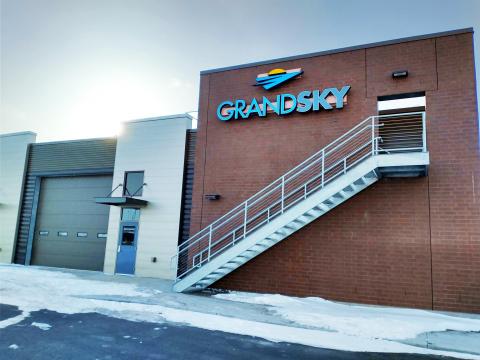
Vantis Prepares North Dakota Ops Center for BVLOS Testing
With its sights set on expanding its beyond visual line of sight (BVLOS) infrastructure across the country, Vantis recently signed a long-term agreement to house an operations center at the Grand Sky business and aviation park in western North Dakota, providing unmanned aerial system (UAS) operators and customers from across industries access to monitoring, data collection, and verification, lowering the barrier to entry for federal approval.
Early performance of hydrogen fuel cell prototype has NWUAV looking forward to new wave in drone propulsion
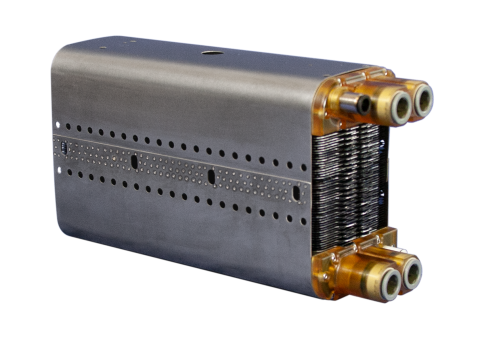
Northwest UAV leaders are excited about early test results for a hydrogen fuel cell prototype that have exceeded expectations and that they hope will herald a trend toward hydrogen-powered propulsion in unmanned flight.
NWUAV, in collaboration with the U.S. Naval Research Laboratory (NRL), is developing the proton-exchange-membrane fuel cell with an eye toward what Chief Technical Officer Jeff Ratcliffe called a growing “middle market” between long-range military drone missions that require internal combustion engines and less demanding military and commercial drone use that tends to rely on battery power.

Wibotic launches software to simplify complexity that comes with keeping large fleets charged
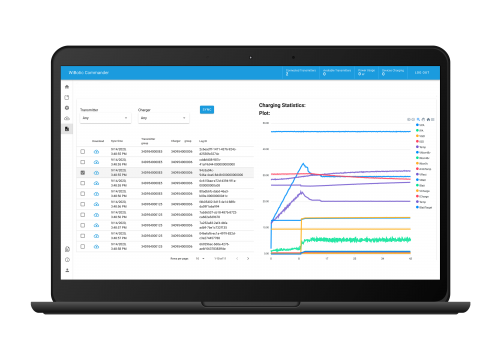
Seattle-based Wibotic last week launched a software package to help customers manage the increasingly complex array of tasks necessary to keep vehicles in growing unmanned fleets charged and ready to perform.
The software, called Commander, offers constant, at-a-glance awareness of all vehicles through a user-friendly interface, said CEO and co-founder Ben Waters. Users will be able to assess quickly how soon vehicles need to be charged, as well as to gather data on things like power usage and battery performance over time – to inform future scheduling and purchasing decisions.
“It might be used for a single vehicle on a single site, or a single vehicle on hundreds of sites, or it could be used for hundreds of vehicles on one site,” Waters said.
COVID-Fighting Collaboration Proves Potential of UAS for Test Transport
Exercise in upstate N.Y. shows how flight could replace drives through downtown traffic.
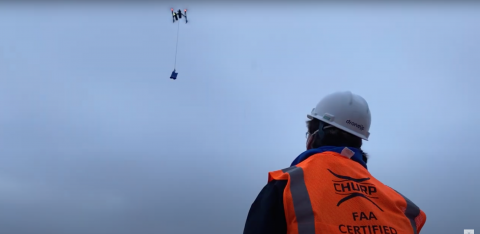
A team of more than a dozen COVID-19-motivated entities with expertise in public health, public safety and unmanned flight recently enjoyed a hard-won peek into the future of UAS in medical transport in upstate New York.
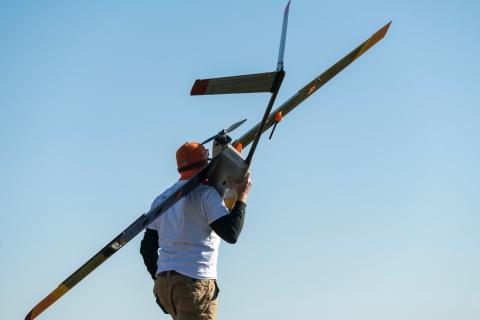
Black Swift Technologies contracts with NOAA to develop a backup navigation system for when standard GPS fails
Jamming. Spoofing. Interference from the landscape or cityscape. Interference from other flight equipment.
Such snarls arise often enough with satellite signals to make it clear: Routine UAS flight beyond the line of sight (BLOS) will likely never happen with traditional GPS technology alone. To assure safe travel over long distances, unmanned aircraft systems need greater capability to ensure accurate positioning and routing.
Sonardyne Technology Selected to Support Fugro's Fleet of Uncrewed Surface Vessels
Technology from Sonardyne has been chosen to support leading geo-data specialist Fugro’s global fleet of uncrewed surface vessels (USVs) and remotely-operated vehicles (ROVs).
Sonardyne’s Mini-Ranger 2 Ultra-Short BaseLine (USBL) position system will be integrated into Fugro’s new 12-meter long Blue Essence USV, the first of which will be delivered to Fugro’s base in Perth in February. Once integrated, the Mini-Ranger 2 will allow the Blue Essence to deploy, track, command and control ROVs and underwater autonomous vessels (UAVs) as part of inspection, survey and data harvesting projects - all of which will be controlled from Fugro’s onshore remote operations centers.

Wingcopter Secures $22 Million in Series A Funding to Aid in COVID-19 Relief
Wingcopter has secured $22 million in Series A funding to strengthen its leadership in drone-based logistics, with a special focus on healthcare-related applications including the distribution of COVID-19 vaccines.
“Our team is driven by tackling the world’s challenges through scalable innovations,” said Wingcopter CEO Tom Plümmer. “This chapter of our journey is dedicated to setting up logistical highways in the sky that leapfrog traditional means of transportation.”
